


Join 8,000 Iceland Travel Fans & Unlock Exclusive Discounts
Get Iceland advice straight from a local. Subscribe and unlock exclusive discounts from 50+ hand-picked Icelandic operators.
- ✔ Instant access to exclusive discount codes
- ✔ Savings on tours, car, and camper rentals
- ✔ Tips and inspiration for planning your Iceland trip
I am not a farmer. I should get that out of the way first.
My most vivid memory from a farm is from when I was four or five.
I had been sent off with my cousins to a remote farm belonging to two brothers, their father’s relatives. At some point, it was decided that we should ride on the trailer behind the tractor. The trailer floor was rough, fragile planks. There was no railing.
One brother drove, full throttle, Mad Max-style, across an uneven field. The other sat on the trailer with us, holding a thin rope. My cousins held the rope too. There was not enough rope for me, so I spent the journey flat on my front on the planks, gripping the wood like a cat that has climbed a tree and understood the situation too late.
I can still see the color of that rope. Light blue.
Over the roar of the diesel engine I could hear our appointed adult shouting, at intervals, “I must take care of the children.” And in the middle of genuine terror, aged four, sliding towards the edge of a moving trailer, the emotion I remember most clearly is not fear. It is frustration. Because apparently I was not in the children’s group, and the children’s group had the rope.
So, no. Not a farmer. But there is one day in the Icelandic farming year when people like me are welcome to stand at the fence and watch, and so are you. Well, I should qualify this by saying that you are welcome, as long as you do not disturb the difficult work going on.
Every summer, around half a million Icelandic sheep are turned loose on the highland commons and left to get on with it. Nobody herds them. Nobody feeds them. They spread out across ground with no roads, no fences, and no people. The sheep roam around in uninhabited areas, from the coast to the highland interior, to graze all summer.
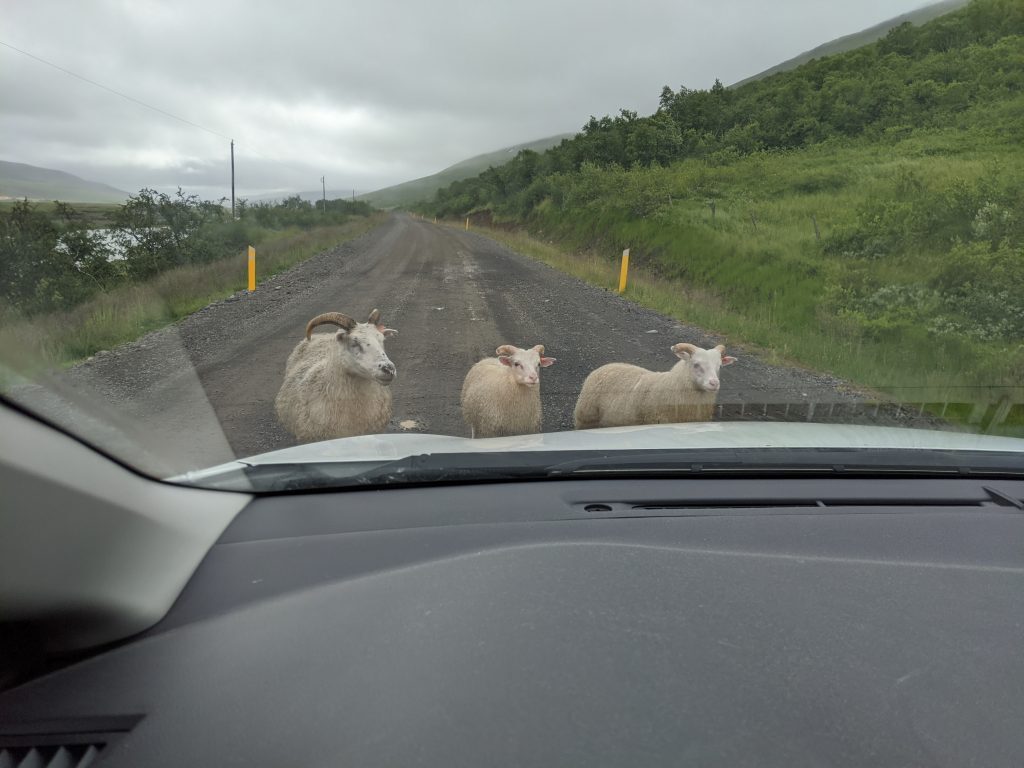
Very often they can be found by roads or on them. This makes it necessary for drivers to be on the lookout for sheep. Be extra careful when a road separates ewes from their lambs. Either the ewe may leap across the road to protect her children, or the lambs may decide it is time to join mummy when they feel threatened by an oncoming car.
Connoisseurs claim they can taste it on Icelandic lamb meat, whether the animal was grazing by the coast or in the highlands. I have to admit that my palate is not so developed. But I have to say Icelandic lamb is delicious.

Then in the fall, somebody has to go and get them back.
That job is called göngur, and the day the sheep arrive at the sorting pens is called réttir. It happens every September, in about a hundred places around the country, and it is the single most Icelandic thing a visitor can stumble into. It is also a working day for the farmers involved, which is the part most travel articles forget to mention.

Here is what actually happens, where you can watch it, and how to be a guest rather than an obstacle.
What réttir actually is
Start with the words, because you will see them on signs and hear them all day.
- Afréttur — the highland common grazing land, shared between the farms of a district.
- Göngur or leitir — the gathering. Riders on horseback, walkers and dogs sweep the afréttur over two to five days, working in from the far edges and pushing everything downhill towards home.
- Fjallkóngur — literally “mountain king”. The person in charge of the gathering. He decides who rides where, when everyone eats and when everyone sleeps. It is an unpaid job with real authority, and it is usually held by the same person for years.
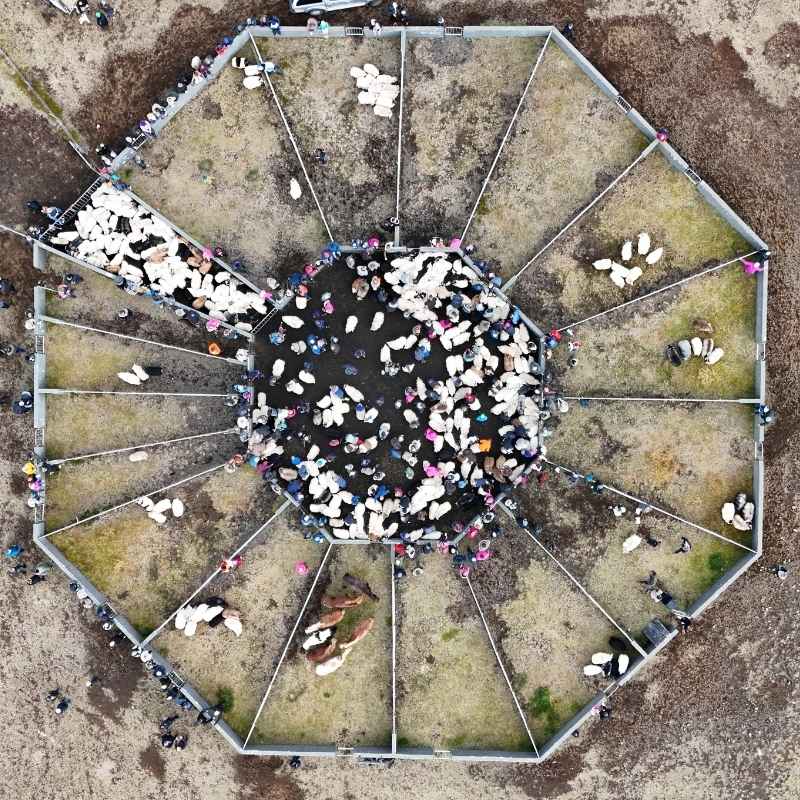
- Rétt — the sorting pen. A big circular corral with smaller pens radiating off it, like slices of a pie.
- Almenningur — the central ring, where all the sheep end up in one enormous woolly mass.
- Dilkur — one of the small pens off the ring. Each farm has its own.
- Réttarball — the dance in the community hall that night. More on that later.
The sheep arrive at the pen in the morning; everything is driven into the almenningur, and then sorting starts. This is the bit worth traveling for.

How the sorting works
Every farm in Iceland has its own registered mark: a specific pattern of notches cut into the sheep’s ears, sometimes combined with a coloured tag or a paint mark on the fleece. The patterns are recorded in a mark register, and farming families learn to read them the way the rest of us learn to read road signs.
So there is no technology involved and no system beyond memory. Somebody wades into the middle of a thousand milling sheep, grabs one, glances at its ear, and drags or carries it to the correct dilkur. Then does it again. And again. For hours.
The people doing it are farmers, their children, their neighbors, their cousins who drove up from Reykjavík for the weekend, and whoever else turned up. Teenagers work alongside men in their eighties. There is a lot of shouting, some of it good-natured. There are dogs everywhere, and the good ones are worth watching more than the sheep are.
You will notice a flask going round. You might be offered a drink from it. That is normal, and it is polite to take a small one, even at nine in the morning.

When réttir happens
Réttir runs from the first week of September into early October. Most of the big ones land on a Saturday or Sunday, because that is when everyone can get there.
Dates are set locally and can shift slightly year to year, so check before you drive four hours. The most reliable sources are the district municipality websites, the local farming association, and the Facebook pages of the individual pens — many of them post their dates in August and then post a photo of the sheep coming down the valley on the morning itself.
| Round-up | Region | Roughly when | Why go |
|---|---|---|---|
| Þverárrétt | Borgarfjörður, West | Mid-September | One of the oldest and biggest. Under two hours from Reykjavík and the ball afterward is well known. |
| Skeiðaréttir (Reykjaréttir) | South Iceland | Mid-September | Very large, easy driving from the Golden Circle, thousands of sheep. |
| Tungnaréttir | Biskupstungur, South | Mid-September | Big southern round-up, straightforward to combine with a Golden Circle day. |
| Stafnsrétt | Svartárdalur, North | Second half of September | Old stone pen in a narrow valley. The one photographers talk about. |
| Auðkúlurétt | Húnavatnshreppur, North | Second half of September | A near-perfect circular pen with the dilkar radiating out. Remarkable from above. |
| Silfrastaðarétt | Skagafjörður, North | Second half of September | Skagafjörður is horse country, so expect a serious turnout of riders. |
If you are driving the Ring Road in September, you will pass within an hour of a réttir at some point almost regardless of your route. It is worth building a Saturday around one.
The ones to leave alone
Not every pen wants visitors. Smaller round-ups with two or three hundred sheep and eight people working them do not have room for a minibus of photographers, and a stranger standing in the wrong gateway can cost them an hour.
The rule of thumb: the big, well-known réttir listed above expect a crowd and are set up for it. If you find a small pen by accident and there is no car park and no one selling coffee, watch from the road for ten minutes, then move on. You will not be thanked for climbing the fence.
Ten rules for behaving yourself
- Park where you are told. If somebody waves at you, they mean it. Lorries and horse trailers need to get in and out all day.
- Never stand in a gateway. Sheep move through gaps, and a person in a gap blocks the gap.
- Stay out of the almenningur unless you are invited in. Sometimes you will be. It is a good offer, and you should take it.
- Do not get between a dog and its sheep. The dog is working, and it is better at this than you are.
- Leave your own dog in the car, or better, at home. This is not negotiable.
- Do not use a drone unless you get explicit permission from the people working there. A drone over a pen full of animals and horses is a genuine hazard. If you get permission to operate a drone, you are legally responsible for damage or accidents you cause with it. Take care not to spook animals or endanger people.
- Ask before photographing people, particularly children. Wide shots of the pen are fine. Faces are different.
- Bring cash. Some pens have a coffee-and-cake stall run by the local women’s association or by a school fundraiser. Buy something. It is the cheapest goodwill you will ever purchase.
- Do not touch or lift the sheep. They are heavier and stronger than you think, and they are somebody’s livestock, not a petting zoo. Also, if you happen to annoy an adult ram, well, remember that he is probably stronger, faster, and angrier than you!
- Say hello. Góðan daginn. That is the whole social contract. Icelanders at réttir are in a good mood, and most of them speak English better than they let on.
What to wear and bring
You are going to stand outside for four hours in September, in a field, in Iceland. Dress for the worst version of that.
- Waterproof jacket and waterproof trousers. Not a shower-resistant jacket. Waterproof.
- Wool base layer, wool jumper, hat and gloves. Wool works when it is wet, which is the whole point.
- Boots you are prepared to hose down afterward. The ground around a sorting pen is mud and manure by ten in the morning.
- A bin bag in the car boot for the boots.
- Your own coffee and food, in case there is no stall.
- No toilets at most pens. Plan accordingly.
You will smell of sheep afterward. Everyone does. It fades.
Getting there
Most sorting pens sit at the head of a valley, up a gravel road, ten to thirty minutes off the paved route. You do not need a 4×4 for the ones listed above, but you do need a car — there is no bus, no tour bus, and no taxi that will take you to a réttir.
Drive gravel slowly and pull over for horse trailers. If there are horses on the road, slow to a crawl and give them room; a startled horse near a car is nobody’s good day. Always follow instructions from the people who are working.
Reader discount: car rental
You need your own wheels for this one. My partners give Stuck in Iceland readers a discount on car rentals, including 4x4s and camper van rentals if you want to sleep near the pen the night before. However, sheep or horses close to cars are never a good mix. I have had my car badly damaged by wayward sheep who decided it was a good idea to bang it up. If livestock damages your car, you will have to pay for the damage yourself. I found out the hard way.
The réttarball
The sorting finishes in the afternoon. The sheep go home on trailers. The people go home, shower, and then come back out to the community hall in the evening for the ball.
A réttarball is a dance, and its format has not changed much for decades. There is a band, or if you are unlucky, an accordion player. There might be a bar, and the age range runs from teenagers to grandparents who have been to this same dance every September since 1968. The music is Icelandic dance-band standards that everyone but you knows the words to. It gets messy. It is entirely good-natured.
Two practical notes. First, some balls are ticketed, and some sell out, so ask at the pen during the day. These gatherings are rowdy, and I would not automatically assume that outsiders are always welcome. You just have to read the room.
Second, and this matters: you cannot drive afterward. Iceland’s drink-driving limit is effectively zero, and rural police know exactly which weeke
nd this is. Book a room within walking distance, or do not drink. Rural Iceland is mostly devoid of taxi services. Again, there is zero tolerance for drunk driving in Iceland. Fines are heavy, and if you mouth off to the police, you will get free overnight one-star accommodation, courtesy of the local sheriff.
Accommodation near the well-known réttir books out weeks ahead. If you want the ball, sort your bed in August.

Horse round-ups: stóðréttir
Sheep are not the only animals brought down from the highlands. Horses are gathered too, later in the season, and the horse round-ups are a different kind of spectacle: hundreds of loose horses driven down a valley at speed, then sorted by hand in the same style of pen.
The best-known is Laufskálarétt in Hjaltadalur, Skagafjörður, usually held on the last weekend of September. It draws thousands of people, including a large contingent of Icelandic horse enthusiasts from Germany and Scandinavia. Confirm the date, book a room early, and expect a proper crowd.
If you only have one weekend and have to choose, sheep réttir is the more intimate experience; stóðréttir is the more dramatic one.
Riding along on the gathering
You can go further than watching. Several Icelandic riding stables take paying guests on the actual göngur — four to six days in the highlands on horseback, sleeping in mountain huts, working the sweep alongside the farmers. It is not a trail ride. You need to be genuinely comfortable in the saddle for eight hours in bad weather, and places sell out the winter before.
If that sounds like your kind of trip, start asking in January for the following September.
Where to soak afterward
The correct end to a day at réttir is hot water. You are cold, you are muddy, and you have earned it.
Most districts with a réttir have a swimming pool within twenty minutes, and the local pool is the cheapest and most authentic option — a few hundred krónur, a hot tub full of farmers discussing the day. If you want something bigger, plan your route past one of the geothermal baths.
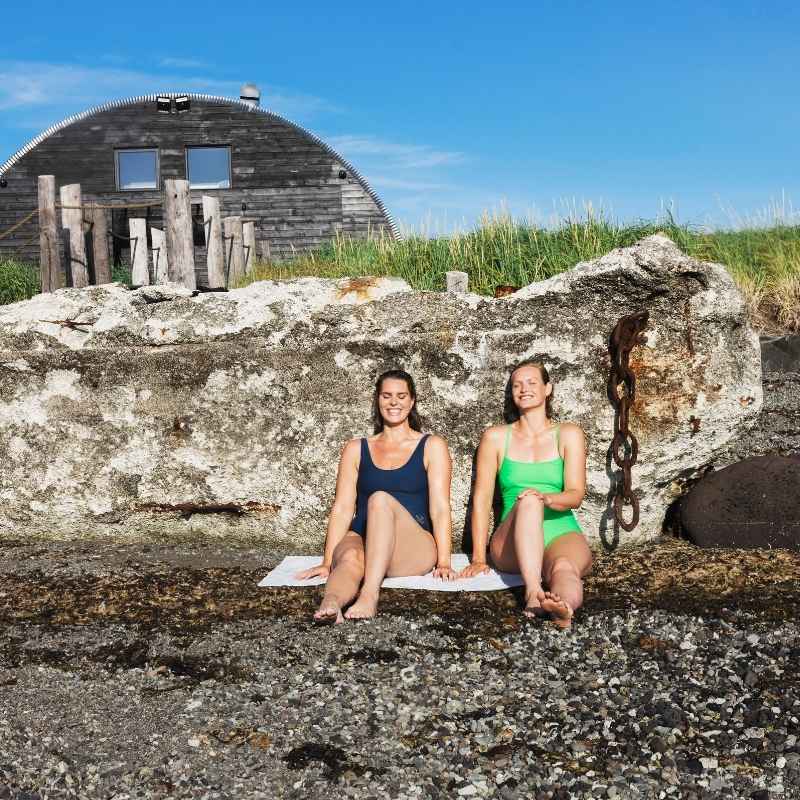
Stuck in Iceland readers get a discount at several of Iceland’s geothermal baths. Handy after a day standing in a field. To get the codes, sign up for my free newsletter. I partner with Vök Baths in eastern Iceland, Krauma in western Iceland, The Secret Lagoon and Laugarás Lagoon on the Golden Circle, and, of course, Hvammsvík near Reykjavik.
Why it is worth your Saturday
Iceland puts a lot of effort into showing visitors its landscape and considerably less into showing them how the country actually works. Réttir is the exception, and nobody organized it for you. It happens because half a million sheep are in the wrong place and someone has to fix that before the snow comes.

You get to stand at the edge of it, in the rain, watching four generations of a farming family do a job their family has done in that same spot for a very long time. Then you go and eat lamb soup, and the connection between the two is not subtle.
That is a better souvenir than a photograph of a waterfall.
Réttir — FAQ
10 questions
Do I need a ticket to attend réttir?+
No. The sorting is a working event on private and communal land, and visitors are generally welcome to watch at the larger pens at no charge. The evening ball is separate and often ticketed.
What time should I arrive?+
Aim to be there by nine in the morning. The sheep are usually driven in early and the sorting starts as soon as they are penned. By early afternoon it is winding down.
Is it suitable for children?+
Very. Icelandic children work at réttir from the age they can walk. Keep them out of gateways and away from the working dogs, and they will have a better day than they would on a bus tour.
Can I take part in the sorting?+
Sometimes, if you are invited. Ask a farmer, be honest that you have never done it, and accept that you may be told no because it slows things down. Do not simply climb in.
Do I need a 4×4 to get to a sorting pen?+
Not for the well-known ones. The access roads are gravel but graded, and a standard car handles them if you drive slowly. Some smaller pens up in the valleys are rougher.
Is réttir cruel to the animals?+
It is loud, and it looks chaotic, but it is the least intrusive livestock system in Europe: the animals live free and unhandled all summer and are handled by hand for one morning a year. Sheep are moved by being carried or led by the horns, not dragged by the fleece.
How many sheep are we talking about?+
It varies enormously. A small district pen might sort three hundred. The largest southern and northern round-ups handle several thousand in a morning.
When exactly is réttir in 2026?+
Individual dates are set each summer locally and fall on weekends between early September and early October. Check the municipality website or the pen’s own Facebook page in August, and confirm again the week before you travel.
Can I visit réttir on a day trip from Reykjavík?+
Yes. Þverárrétt in Borgarfjörður and the larger South Iceland round-ups are all within a two-hour drive of the capital, which makes a long but comfortable day.
What should I say to people?+
Góðan daginn — good day. That covers it. Most people at réttir speak English and are in a good mood, and being visibly interested in what they are doing goes a long way.
Did you enjoy this article?
Get more Iceland insight — straight from a local who's lived here his entire life
Join 8,000 travellers getting honest Iceland advice and unlock exclusive discount codes from 50+ hand-picked Icelandic operators.- ✔ Instant access to exclusive discount codes
- ✔ Savings on tours, car and camper rentals
- ✔ Tips and inspiration for planning your Iceland trip
No spam. Unsubscribe any time.