

Join 8,000+ Iceland travel fans and unlock the reader discounts
Get Iceland advice straight from a local, once a week. Subscribe and unlock discount codes from 50+ hand-picked Icelandic companies.
- Instant access to the reader discount codes
- Savings on tours, hot springs, car and camper rentals
- Tips and ideas for planning your Iceland trip
Free, once a week. Unsubscribe any time.
Icelandic is not the most user-friendly language in the world. But you’re curious, and that already puts you ahead of most visitors. Below are the phrases that will actually serve you when you’re standing in a Reykjavík café, navigating a checkout queue, or just trying to say thanks properly. I’ve written each one with a simple “say it like” pronunciation guide — no linguistics degree required.
Quick answer: the 5 Icelandic phrases you really need
If you learn nothing else before your trip, learn these:
Free road trip plans with maps
Day-by-day plans for the four drives most people take, each on an interactive map with where to sleep, fuel stops, waterfalls and reader discounts along the way. Built for a relaxed pace, not a race.
See all road trip plansMap of hot springs, spas and pools
Every lagoon, wild hot spring and town pool in Iceland on one map. Find warm water near you, and see which spas give my readers a discount.
- 57 places to soak
- % Reader discounts
– Já (yow) – yes
– Nei (nay) – no
– Takk (tahk) – thanks
– Halló (hah-LOH) – hello
– Talar þú ensku? (TAH-lar thoo EN-skoo) — Do you speak English?
These five will get you through almost any everyday situation. Everything below is a bonus.
Two Icelandic letters you’ve never seen before
Before we go further, the two letters that throw most visitors:
– þ (thorn) – pronounced like the “th” in *think* (unvoiced). You’ll see it at the start of words: *þú* (thoo) means “you.”
– ð (eth) – pronounced like the “th” in *this* (voiced). You’ll see it inside or at the end of words: *góðan* (GOH-than) means “good.”
Stress almost always falls on the first syllable. That’s most of what you need to start sounding less like a tourist.
How to say hello in Icelandic
– Halló (hah-LOH)* — hello. Casual, works anywhere.
– Góðan daginn (GOH-than DYE-in) — good day. The polite greeting in shops, cafés, and taxis. This is the one that earns you a warmer welcome.
– Gott kvöld (gott KVERLD) – good evening.
– Hvernig hefur þú það?*(KVED-nig HEH-voor thoo thah) – how are you?
**Try this today:** Walk into a bakery in Reykjavík and lead with *Góðan daginn* instead of “hi.” You’ll feel the difference in the reply.
How to say goodbye in Icelandic
– Bless (bless) – goodbye. Yes, just “bless.” Often doubled to *bless bless*, which sounds more friendly.
– Góða nótt (GOH-tha noht) – goodnight.
– Sjáumst (SYOWMST) – see you (casual).
The most useful Icelandic word: takk
If you take only one word with you to Iceland, take *takk*. I use it dozens of times a day. It opens doors, it smooths over small awkwardness, and it costs nothing.
– Takk (tahk) – thanks
– Takk fyrir (tahk FIH-rir) – thank you (slightly more formal)
– Takk kærlega (tahk KIRE-leh-ga) – thanks very much
– Ekkert að þakka (EH-kert ath THAH-ka) – you’re welcome (literally “nothing to thank for”)
– Takk fyrir mig (tahk FIH-rir mig) – said after a meal, especially at someone’s home; literally “thanks for me,” meaning “thanks for having me.”
How do you say “please” in Icelandic?
Honestly, Icelandic doesn’t really have a one-to-one “please.” The closest is vinsamlegast (VIN-sahm-leg-ahst)*, but it’s quite formal. Icelanders tend to embed politeness in tone and phrasing rather than tagging on a single word. Don’t worry about it — takk at the end of a request does most of the work.
How to say sorry or excuse me in Icelandic
– Afsakið (AHF-sah-kith) — excuse me / sorry (the everyday one)
– Afsakið mig (AHF-sah-kith mig)* — excuse me (getting someone’s attention)
– Fyrirgefðu (FIH-rir-gev-thoo)* — I’m sorry (a more sincere apology)
Try this today: Squeezing past someone in a busy café? Afsakið with a small nod.
What to say when you don’t understand
– Ég skil ekki (yeg skil EH-ki)* — I don’t understand
– Talar þú ensku? (TAH-lar thoo EN-skoo) – do you speak English? Most Icelanders speak good English, even if they tend to underestimate their own fluency.
– Ha? (hah) – what? Casual, very common, and not rude. Real Icelanders say this to each other constantly. Don’t be shy with it.
How to order coffee in Icelandic
You’ll be fine asking in English at any café — and honestly, you’ll often find non-native baristas anyway. But if you want to try:
– Get ég fengið kaffi? (get yeg FENG-ith KAH-fee) – could I have a coffee?
– Get ég fengið vatn? (get yeg FENG-ith vahtn) – could I have water?
– Reikninginn, takk (REK-ning-in tahk) – the bill, please
Try this today: Order your first morning coffee in Icelandic. Worst case, you smile and switch to English. Best case, you make someone’s morning.
How to order a beer in Icelandic
– Einn stóran bjór, takk (eitn STOR-an byor tahk) — one large beer, please
– Tvo stóra bjóra, takk (tvoh STOR-a BYOR-a tahk) — two large beers, please
– Skál! (skowl) — cheers!
If you want to know what to budget for that beer and everything else, here’s how to pay for things in Iceland and tips for visiting on a budget.
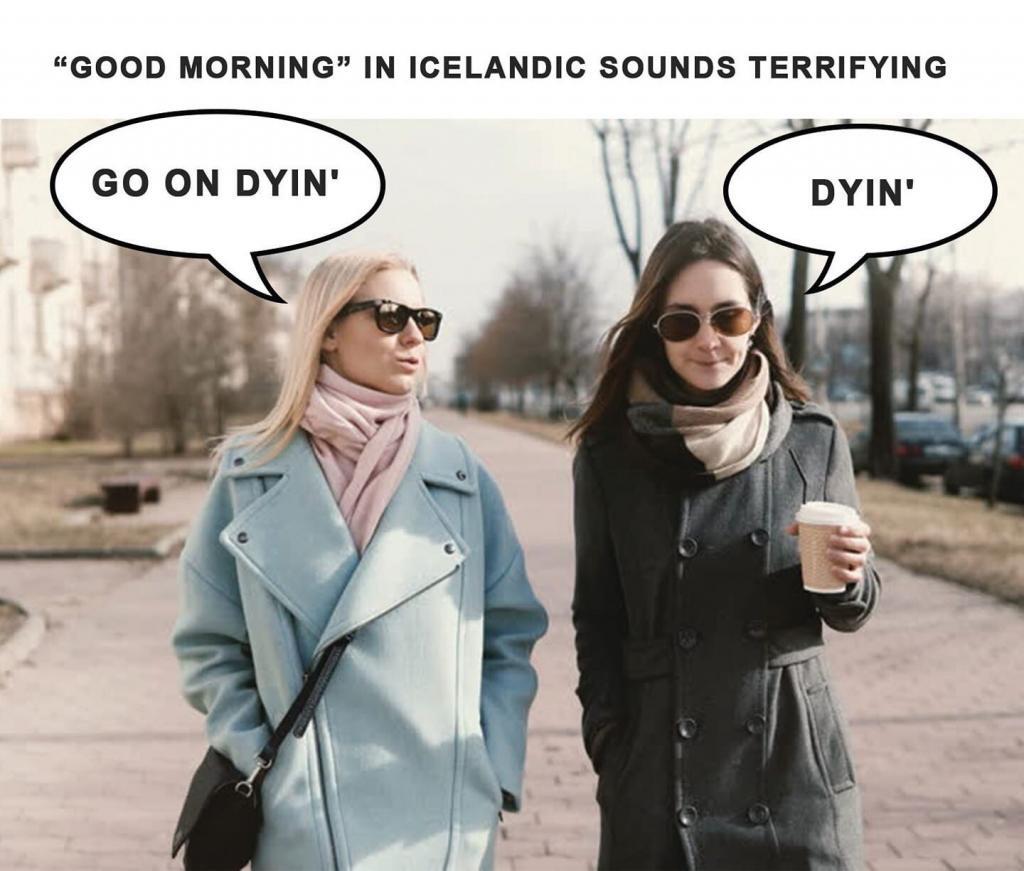
Numbers 1–10 in Icelandic
Useful for ordering, prices, and counting your beers at home.
– 1 – einn (eitn)
– 2 – tveir (tvayr)
– 3 – þrír (threer)
– 4 – fjórir (FYOR-ir)
– 5 – fimm (fim)
– 6 – sex (sex)
– 7 – sjö (syoh)
– 8 – átta (OW-ta)
– 9 – níu (NEE-oo)
– 10 – tíu (TEE-oo)
In an emergency
Iceland is one of the safest countries in the world, but it’s worth knowing these just in case:
– Hjálp! (hyowlp) – help!
– Ég þarf lækni (yeg tharf LIKE-nee) – I need a doctor
– Lögreglan (LOG-reh-glan) – the police
– 112 – the all-purpose emergency number in Iceland (police, ambulance, search and rescue)
For more on staying safe out on the road and in the weather, see how to travel safely in Iceland.
The mystery of “já”
*Já* technically means yes. But it’s also Iceland’s favorite filler word. It’s an exclamation of surprise, a thinking pause, a polite hedge, sometimes even a soft disagreement. Listen for it once, and you’ll hear it everywhere.
Yes, Icelanders sometimes speak on the inhale
You’ll hear it: a quick, sharp *já* said while breathing in. Foreigners used to think it was tuberculosis. It isn’t. It’s just a way of agreeing quickly without breaking the flow of conversation. Try it once, and you’ll feel oddly local.
If you’re shocked by something, you might also hear: **Ég trúi þessu ekki** *(yeg TROO-ee THEH-soo EH-ki)* — “I don’t believe it” — said on the inhale.
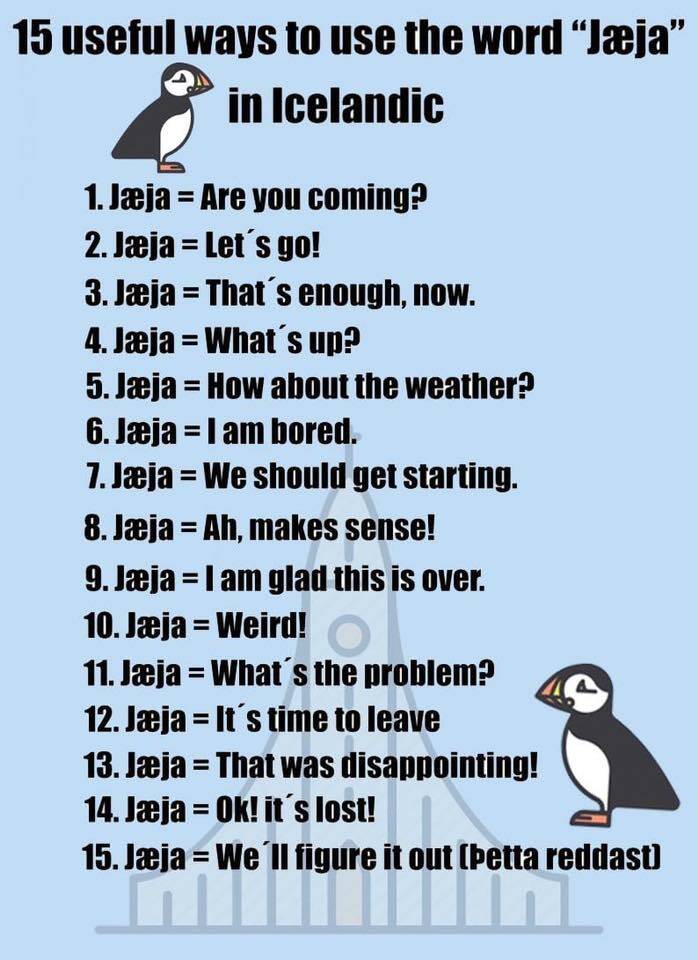
Jæja: one word, a thousand meanings
Jæja *(YIGH-yah is the Swiss Army knife of Icelandic. It roughly translates to “well then” or “there we are,” but in practice it signals: time to leave, time to start, oh dear, finally, okay let’s go, I’m sorry to hear that, and about fifty other things — all from context and tone.
Your Icelandic cheat sheet
Screenshot this:
| English | Icelandic | Say it like |
|---|---|---|
| Yes | Já | yow |
| No | Nei | nay |
| Hello | Halló | hah-LOH |
| Good day | Góðan daginn | GOH-than DYE-in |
| Thanks | Takk | tahk |
| You’re welcome | Ekkert að þakka | EH-kert ath THAH-ka |
| Excuse me / sorry | Afsakið | AHF-sah-kith |
| Do you speak English? | Talar þú ensku? | TAH-lar thoo EN-skoo |
| I don’t understand | Ég skil ekki | yeg skil EH-ki |
| Cheers! | Skál | skowl |
| Goodbye | Bless | bless |
| Help! | Hjálp | hyowlp |
More resources for learning Icelandic
For a much deeper dive into the language and culture, I recommend the All Things Icelandic podcast by Jewells Chambers. Over on YouTube, Cool Icelandic Lessons is a good starting point. Furthermore, my partner, Speak Viking, offers online Icelandic language courses. Sign up for the Stuck in Iceland Newsletter to receive a discount code that saves you money on their courses.
And once you’re ready to put these phrases to use, here’s how to plan your Iceland trip from start to finish.
Frequently asked questions about the Icelandic language
Do I need to learn Icelandic to travel in Iceland?
No. Almost every Icelander you’ll meet — especially in tourism, hospitality, or under the age of 60 — speaks good English. Learning a few phrases is a courtesy, not a necessity.
How do you pronounce Reykjavík?
RAY-kya-veek. Three syllables, with the stress on the first.
What is the hardest part of Icelandic for English speakers?
The two unusual letters (þ and ð) and the grammar, which has four cases and conjugates almost everything. But the pronunciation of basic travel phrases is more forgiving than people fear.
Is Icelandic similar to other Scandinavian languages?
It’s related — they share Old Norse roots — but Icelandic has preserved much older grammar and vocabulary. A modern Norwegian or Swede generally cannot understand spoken Icelandic.
What does “takk fyrir mig” mean?
Literally “thanks for me” — Icelanders say this after a meal, meaning “thanks for having me.” Very useful if you’re invited to someone’s home.
What’s the best way to practice Icelandic phrases before my trip?
Pick five from the cheat sheet above, say them out loud once a day for the week before you fly, and use them on day one. Confidence beats accuracy.
Did you enjoy this article?
Get more Iceland insight, straight from a local who's lived here his entire life
Join 8,000 travellers getting honest Iceland advice and unlock discount codes from 50+ hand-picked Icelandic companies.
- Instant access to the reader discount codes
- Savings on tours, hot springs, car and camper rentals
- Tips and ideas for planning your Iceland trip
No spam. Unsubscribe any time.