

Join 8,000 Iceland Travel Fans & Unlock Exclusive Discounts
Get Iceland advice straight from a local. Subscribe and unlock exclusive discounts from 50+ hand-picked Icelandic operators.
- ✔ Instant access to exclusive discount codes
- ✔ Savings on tours, car, and camper rentals
- ✔ Tips and inspiration for planning your Iceland trip
I am afraid of heights. However, I have challenged my fear quite a bit over the years. I have completed the military-grade death march of the Glerárdalur 24 peaks in 24 hours and trekked up to Hrútfjallstindar, Iceland’s highest peak, Hvannadalshnúkur. I have crossed a few rickety hanging bridges over rivers in Nepal to cross huge rivers. Most recently, I successfully challenged my paralyzing fear of heights on the Icelandic Fálkaskettur Via Ferrata on Mt. Esja, just 20 minutes from Reykjavík.
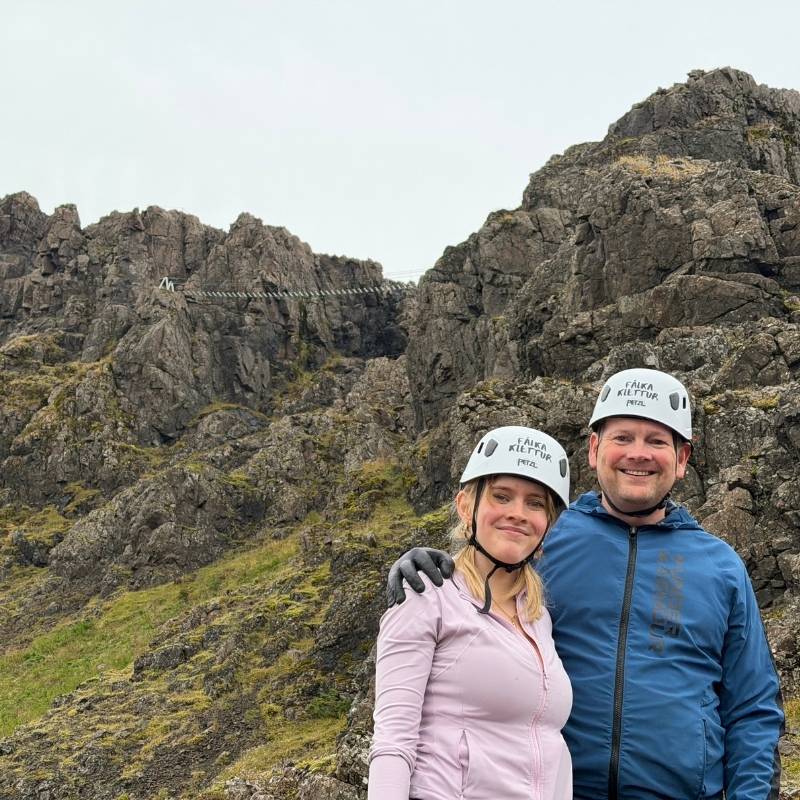
Joined by my favorite adventure partner
I went on a Sunday to join the Fálkakleetur Via Ferrata tour*. The weather was perfect for the activity: calm, overcast, and 12 degrees Celsius. That is 53 degrees for those of you who still use the Fahrenheit scale. My favorite adventure (and gym) partner, my daughter Ragnheidur, came along to show her dad moral support. We were a part of a nice group of local people, people from Denmark and Poland.
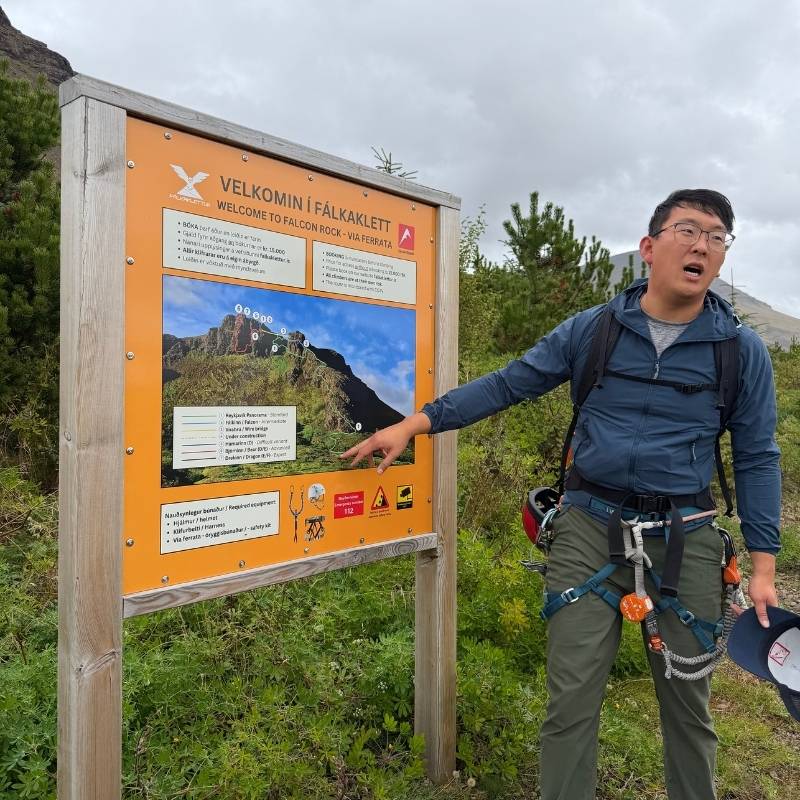
The super-impressive guide
We had an excellent guide, Daniel Byung-chan Roh, who originally hails from Virginia, USA. He is a good friend whom I met when we teamed up for a grueling session at Mjölnir gym. Daniel, a super-fit guy, showed me patience and kindness during the exercise session. He told me about Via Ferrata and that he was a guide. I was intrigued, and finally I took the plunge. Daniel is versatile; he teaches English at the International School of Iceland and is the Artistic Director of the stand-up comedy show Belonging, which focuses on immigrants’ experiences in Iceland. He also holds multiple qualifications as a mountain guide.

A concept born in the cauldron of World War Alpine combat
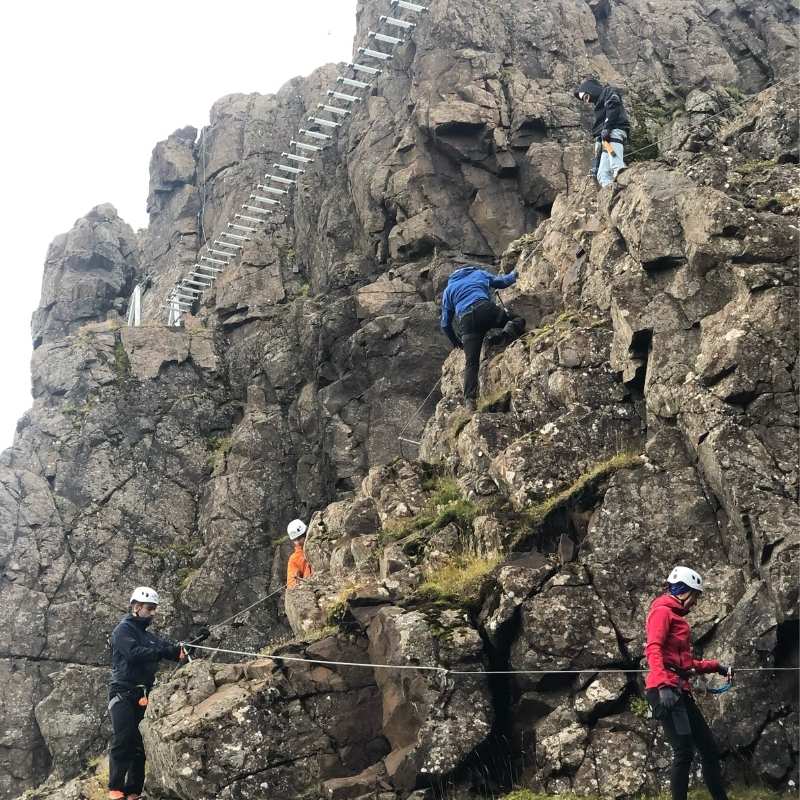
Daniel told the group during his introduction that the concept of Via Ferrata (Iron Road) was born during the fierce combat in the alpine region between the then Austrian-Hungarian Empire* and Italy during World War One. Moving equipment, weapons, and soldiers in the mountains was a tremendous challenge. The solution was to create a network of routes by installing hanging bridges and handrails in the form of cables bolted to the rock.
Via Ferrata on Fálkaklettur is an engineering feat
This is what has been done at Mt. Esja, and it is an engineering feat.
At the start of the tour, you are issued a helmet and a climbing harness with two thick cords attached. Each cord ends in a carabiner, also known as a mountain clip. Then you walk to the route’s starting point, where you are taught how to use the carabiner. Since you have two clips, the rule is simple. Clip both carabiners to the steel cable. Make sure the clips are attached in opposite directions. Then you start climbing. When you reach a bolt, unclip one carabiner and clip it to the other side of the bolt. Then you can safely clip the other one to the cable on the right side of the bolt. And so on and so forth.
I want to comment especially on the cable and the bolts. The steel cables and bolts are new. The bolts are drilled deep into the rock and secured. Experienced mountaineers set up the Via Ferrata route on Fálkaklettur, and it shows.
Hey, I am not terrified up here!
At no point did I feel unsafe, even when I was just tipping the toes of my boots on a slit of rock, hauling myself up a vertical cliff with a 50-meter drop below me. Falling would be instant death. This feeling of security in those situations was just extraordinary for me.
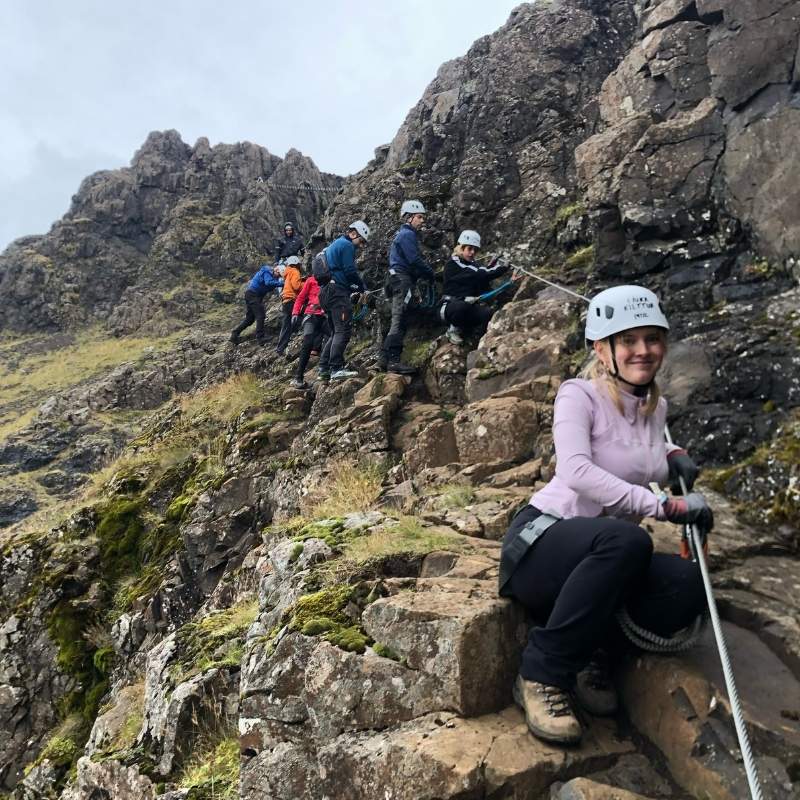
My daughter, entirely unbothered, while the rest of us catch up. Photo by Daniel Byung-chan Roh.
Another thing Via Ferrata Iceland does well is offer alternative routes. Don’t want to do the super steep stretch? No problem, you are welcome to take an easier route.

Griping about safety
I must admit, at times I thought the level of security was a bit of overkill, and yes, I was wrong. I had one moment when I hauled myself up an impossibly steep passage and was about to proceed. Then the harness tugged, and I couldn’t move further up. I had to go down to unclip my carabiners. Graciously, Daniel took care of this for me. I am not the most flexible guy in the world, and finding my way down would have been awkward but doable, of course.
The supercool hanging bridge
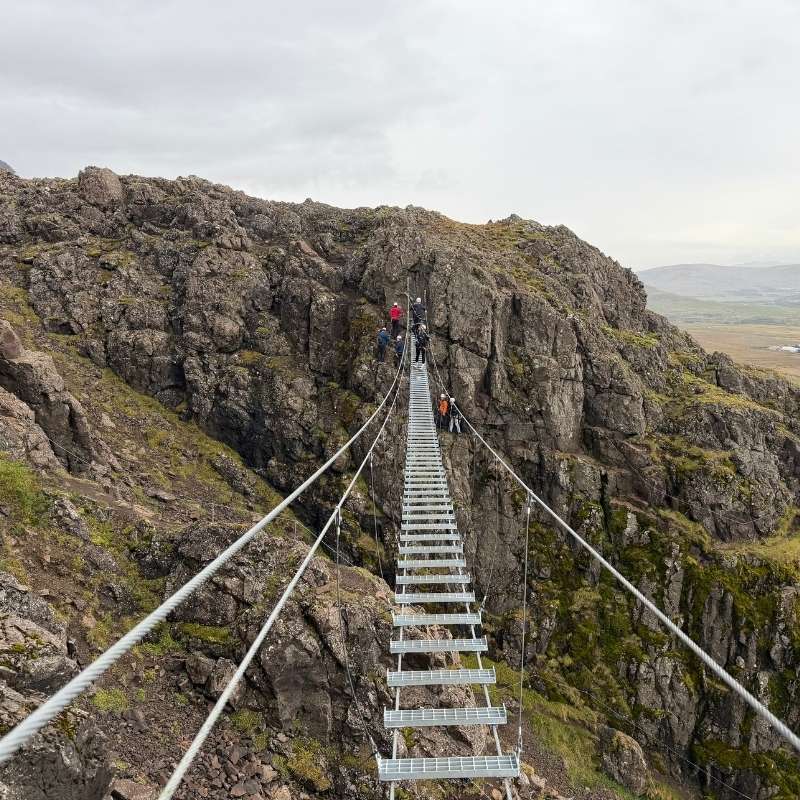
Then there is the hanging bridge over a deep ravine. Like the other infrastructure, it is a nice piece of engineering. Steel cables run across the ravine, and you clip onto them to walk safely over it. Walking across it was a breeze. Compared to walking across a hanging bridge made with timber and rope to cross a raging river in Nepal, this was nothing!
At the top, you are rewarded with a very nice view of Reykjavik and its surroundings. The trip down was not difficult at all.

I recommend the Fálkaklettur Via Ferrata
All in all, I heartily recommend Via Ferrata. But I would say the following: You need decent upper-body strength and a strong grip. You’ll pull yourself up with your arms and hold on with your hands for long stretches. It helps to be reasonably flexible and not have an uncontrollable fear of heights.
But what is ‘good physical shape’? You can use me as a comparison: I am 53, not at all flexible (!), I work out three times a week, and I commute to work by bike every day of the year. My lack of flexibility was a bit unhelpful on a few stretches. Maybe I should start stretching after workouts? Ah, well, maybe next year!
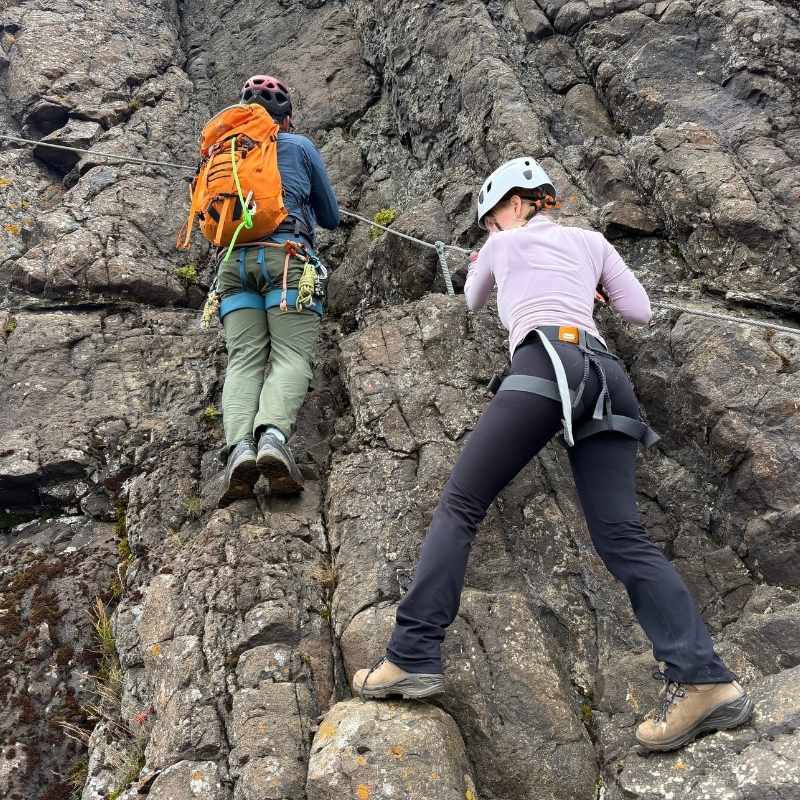
Daniel leading, Ragnheiður following. You can see the cable running across the face: that is what you are clipped to the whole way.
* Via Ferrata is Italian for “Iron Road”
* *As a history nerd, I am delighted to finally be able to mention the famously dysfunctional Austrian Hungarian Empire in my magazine.
Frequently asked questions about the Fálkaklettur Via Ferrata
What is a via ferrata?
Via ferrata is Italian for “iron road.” It is a climbing route fitted with steel cables, iron rungs and bridges bolted into the rock, so you can move up steep ground while clipped to a cable instead of climbing on ropes. The idea comes from the Alps during the First World War, when armies needed to move soldiers and equipment through the mountains. Fálkaklettur on Mt. Esja is Iceland’s version.
Do I need climbing experience to do the Fálkaklettur Via Ferrata?
No. You are issued a helmet and a harness with two lanyards, each ending in a carabiner, and the guide teaches you the clipping system before you start. The rule is simple: both clips stay on the steel cable, and at each bolt you move one clip at a time, so you are never detached from the cable. If you can follow that, you can do the route.
How fit do you need to be for the Via Ferrata on Mt. Esja?
You need decent upper-body strength and a strong grip. You pull yourself up with your arms and hold on with your hands for long stretches, and your hands and forearms tire before your legs do. Being reasonably flexible helps too. Use me as a benchmark: I did it at 53, I work out three times a week and cycle to work year-round, and I was fine — though my lack of flexibility was unhelpful on a few sections. The operator asks for a normal fitness level and no previous climbing experience.
Can I do the via ferrata if I am afraid of heights?
Probably, as long as the fear is not paralysing. I am afraid of heights and I got through it. Being clipped to a steel cable the whole way makes a real difference: at no point did I feel unsafe, even standing on a narrow ledge with a long drop below me. If you know that heights freeze you completely, this is not the trip for you.
Is the Fálkaklettur Via Ferrata safe?
It is built properly. The steel cables and bolts are new, the bolts are drilled deep into the rock, and experienced mountaineers set the route up. You stay clipped to the cable from the start of the route to the top, and the equipment meets European safety standards. The guides brief you before you climb and keep an eye on you throughout.
Can I skip the steepest sections?
Yes. There are easier alternative lines around the steepest stretches. If you would rather not take the hardest passage, say so and your guide will point you to the alternative.
How long does the tour take and how much climbing is there?
Plan for around three hours from start to finish, with roughly 250 metres of ascent. That includes the safety briefing, the walk to the start of the route, the climb itself and the way back down.
What is the suspension bridge like?
It crosses a ravine between two rock faces on open metal slats, with steel cables running along both sides. You clip onto the cables before you step on, then walk across. The bridge slopes uphill, so you are walking up as well as across, and you can see straight down through the slats. It looks dramatic from a distance and it is a nice piece of engineering, but crossing it is easier than it looks — far less alarming than the timber-and-rope bridges over rivers in Nepal.
Where does the Via Ferrata start and how do I get there?
The meeting point is the Mt. Esja Hiking Center (Esjustofa), around 20 to 25 minutes from central Reykjavík. You drive north on Route 1 and turn off towards Esjustofa. There are toilets at the hiking centre, but none on the route itself, so use them before you set off.
Is there an age or weight limit?
Yes. There is a minimum age of around 14, with younger teenagers needing an adult along, and the harness system has both a lower and an upper weight limit. These limits exist for the equipment to work as it should, so check the current ones with the operator when you book.
What should I wear and bring?
Hiking boots with ankle support and good grip, long trousers, warm layers and a windproof jacket. Bring water and something to eat, and gloves with grip for the cables — the operator has gloves you can borrow. Leave the big backpack at the trailhead; it only gets in the way on the rock.
When can you do the Via Ferrata in Iceland?
The season usually runs from spring into autumn, roughly April to October, and tours outside that window can sometimes be arranged if conditions allow. Trips depend on the weather, so check with the operator before you travel out there.
Did you enjoy this article?
Get more Iceland insight — straight from a local who's lived here his entire life
Join 8,000 travellers getting honest Iceland advice and unlock exclusive discount codes from 50+ hand-picked Icelandic operators.- ✔ Instant access to exclusive discount codes
- ✔ Savings on tours, car and camper rentals
- ✔ Tips and inspiration for planning your Iceland trip
No spam. Unsubscribe any time.
I'm Afraid of Heights. I Did the Via Ferrata on Mt. Esja Anyway