

Join 8,000 Iceland Travel Fans & Unlock Exclusive Discounts
Get Iceland advice straight from a local. Subscribe and unlock exclusive discounts from 50+ hand-picked Icelandic operators.
- ✔ Instant access to exclusive discount codes
- ✔ Savings on tours, car, and camper rentals
- ✔ Tips and inspiration for planning your Iceland trip
The Eastfjords are the part of Iceland that most travelers admit they ran out of time for. The Ring Road slings you down the south coast, past Vatnajökull and Höfn, and by the time you reach the east, you’ve usually got a ferry to catch in Seyðisfjörður or a long drive ahead to Akureyri. The fjords themselves — narrow inlets, steep mountains dropping straight into the sea, fishing towns that have been quietly going about their business for over a century — get half a glance from the car window.
That’s a pity, and it’s also fixable. Spend time there, and you will discover the wonder of the Eastfjords.
Introducing Fjarðarferðir and their RIB boat tours
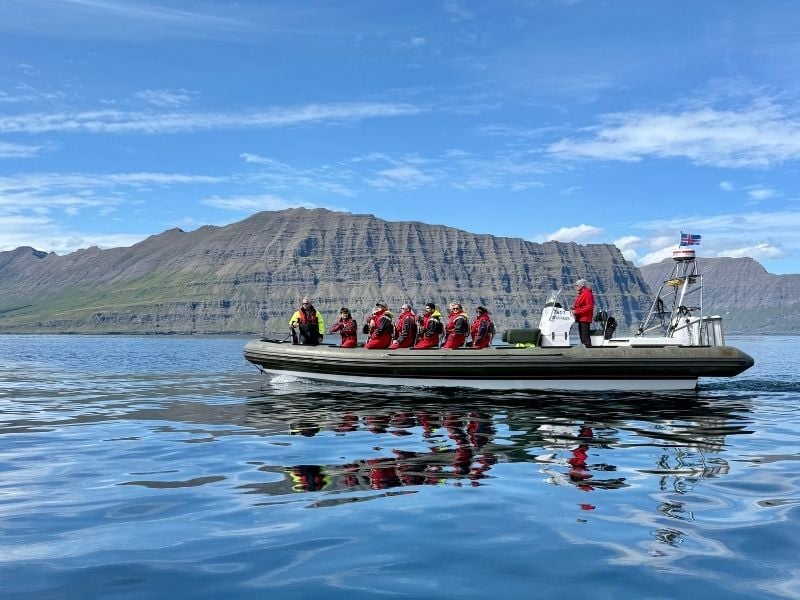
One of the better ways to do that is from the water. A new partner of mine, Fjarðaferðir, runs RIB boat tours out of Neskaupstaður, the biggest town in the east. Their signature trip takes you past the red cliffs of Rauðubjörg, into Páskahellir (the Easter cave), around the headland of Nípan, and into the quiet of Hellisfjörður. Fjarðaferðir sits inside the Elding family — the same Reykjavík operator most of you already know from whale watching in Reykjavik and Akureyri. Elding is one of my venerable partners, btw.
I asked Guðrún Ósk Friðriksdóttir, who heads up sales and marketing at Fjarðaferðir, to walk us through it. Guðrún has been with Elding since 2018 — first in the ticket office, then as a deckhand on the boats, then in sales — and she’s a licensed RIB skipper now working toward her captain’s permit on the larger vessels. She’s also finishing a master’s thesis in Innovation, which is the sort of detail that tells you Fjarðaferðir is in capable hands.

Sign up for the Stuck in Iceland newsletter, and you’ll get a code for 10% off the Fjarðaferðir tour.
Walk me through a Fjarðaferðir RIB tour out of Neskaupstaður. What does the route look like, and what’s the moment most guests remember when they step off the boat?
We start at Beituskúrinn – The Bait Shack – about 30 minutes before departure. That’s where you get in our special overalls, which double as flotation suits, plus life vests and gear. You’ll also meet your guide and captain before we board.
Then we’re off. The first stop is inside Páskahellir, Easter Cave – a sea cave carved by centuries of waves into the base of the cliffs. Approaching it from the water, the scale of the opening catches people off guard. From there, we pass Nípan, Iceland’s tallest sea cliff, rising straight out of the ocean. Puffins, auks, gulls – the skies are full of life, and your guide brings the ecology and hidden stories of this coastline to life.
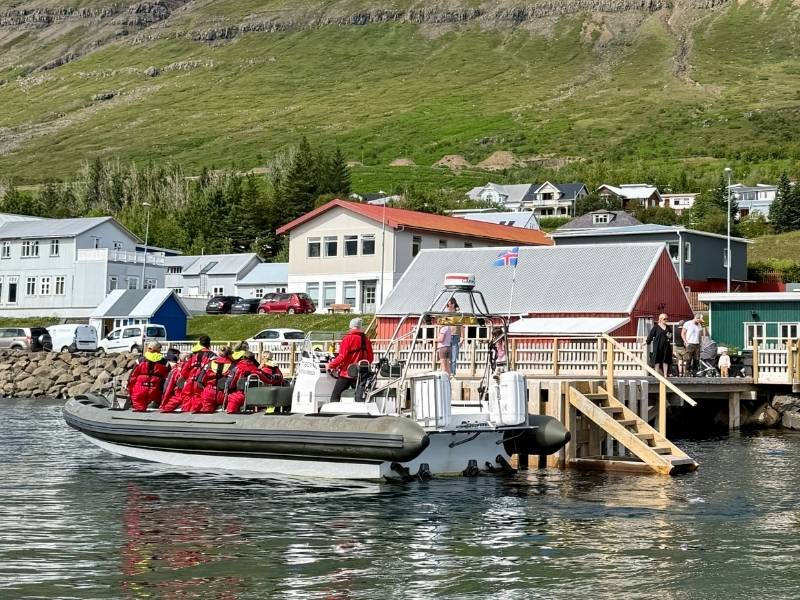
Then Rauðubjörg. Vivid red rhyolite and curved basalt columns that look almost unreal – like nature built its own cathedral. We slow down there, take it in, take photos. Then we continue to Hellisfjörður, a quiet fjord where the remains of an old whaling station sit undisturbed.
And then you’re back at Beituskúrinn, where a drink is waiting to toast the experience.

What guests remember most? It’s usually the moment at Rauðubjörg — when those cliffs come into view, and the color hits you. People just go quiet. But honestly, what stays with most guests is the cumulative effect of it all — the cave, the sea cliff, the colors, the wildlife, the silence of that final fjord — experienced from the water, at speed, from angles no hiking trail can ever give you. It’s the kind of tour where people step off the boat and immediately start telling someone else about it.
Practical question: which months are the boat tour at its best, and what should guests actually turn up in? An open RIB rewards travelers who dress for it — and I assume Fjarðaferðir outfits them for the rest.
We run from June through August, with three daily departures at 13:00, 15:00, and 17:00. Each tour is about an hour. All three months are excellent — this is peak season and the conditions are generally great.
We provide flotation suits and life vests, so the essentials are covered. But I’d always recommend wearing warm layers underneath, and bringing gloves and a hat — even in summer, the sea air at speed is colder than people expect. Sunglasses are a good idea too. Forgot yours? Don’t worry — we have goggles that will keep the wind out.

Most Ring Road travelers give the Eastfjords a short time. What would you have a first-timer do in the east, beyond your boat tour?
I’d definitely recommend slowing down and spending at least a couple of days exploring the Eastfjords instead of just driving through. The Eastfjords reward people who aren’t in a hurry, and the region has far fewer crowds than the south coast, which is part of what makes it special.
Beyond the tour, I’d point people towards Seyðisfjörður for its atmosphere and the famous Rainbow Street. Borgarfjörður eystri is wonderful for hiking and puffin watching at Hafnarhólmi. The Vök Baths near Egilstaðir are a beautiful geothermal experience – not as well-known as the Blue Lagoon, but far more relaxed. Hengigoss and Stuðlagil are both stunning and worth the detour. And don’t miss the local swimming pools – they’re where you’ll meet actual Icelanders.
My broader advice: you don’t need to see all of Iceland in one trip. Pick a region, go deep, and enjoy it. You can always come back. Visit Austurland has a great travel route called Fjord to Fjord – worth checking out at least. It is a lovely framework for exploring the area at a human pace.
What have you learned about how visitors plan their trip to Iceland that you wish more of them knew before they booked?
One thing I’ve learned is that many visitors underestimate both the distances and how much time they actually need to enjoy Iceland properly. A lot of people try to fit the entire ring road into a very short trip, which often turns into more driving than experiencing.
I wish more travelers knew that slowing down and spending extra time in fewer places usually leads to a much better experience and leaves room for the unexpected.
Weather changes fast here — flexibility in your itinerary isn’t just nice to have, it can be the difference between seeing something extraordinary and missing it entirely.
I’d also always recommend talking to locals and asking for recommendations along the way. Some of Iceland’s most memorable places are the ones you won’t necessarily find in guidebooks — small hidden gems, quiet towns, scenic detours, and unexpected stops that end up becoming highlights of the trip.
As our friends at Visit Reykjavík put it: Step lightly, enjoy deeply. Tiptoe through Iceland rather than racing through it – you’ll connect with the nature and culture in a much more meaningful way.

Where do you send friends who come to visit you in the east? A meal, a swim, a walk — the kind of thing that doesn’t always make it into the guidebooks.
I tell them to drive the fjords with no strict plan and stop whenever the view looks good. That alone is worth the trip. There’s something about the light here in the evenings — the way it catches the water between the fjords — that you just can’t rush through.

Hike to Páskahellir – Easter Cave
For a walk, I always recommend hiking to Páskahellir — Easter Cave — either before or after the boat tour. The trailhead is easy to find, the path is suitable for most fitness levels, and the cave itself is genuinely impressive up close. You can walk right inside it, and there’s history along the way explaining how it formed and what this coastline meant to the people who lived here. What I love about it is that you’ll have already seen it from the water on the tour — this dramatic opening in the cliff face — and then you get to stand inside it. Two completely different perspectives on the same place. That kind of layered experience is what the Eastfjords do best.
Soak at Vök Baths
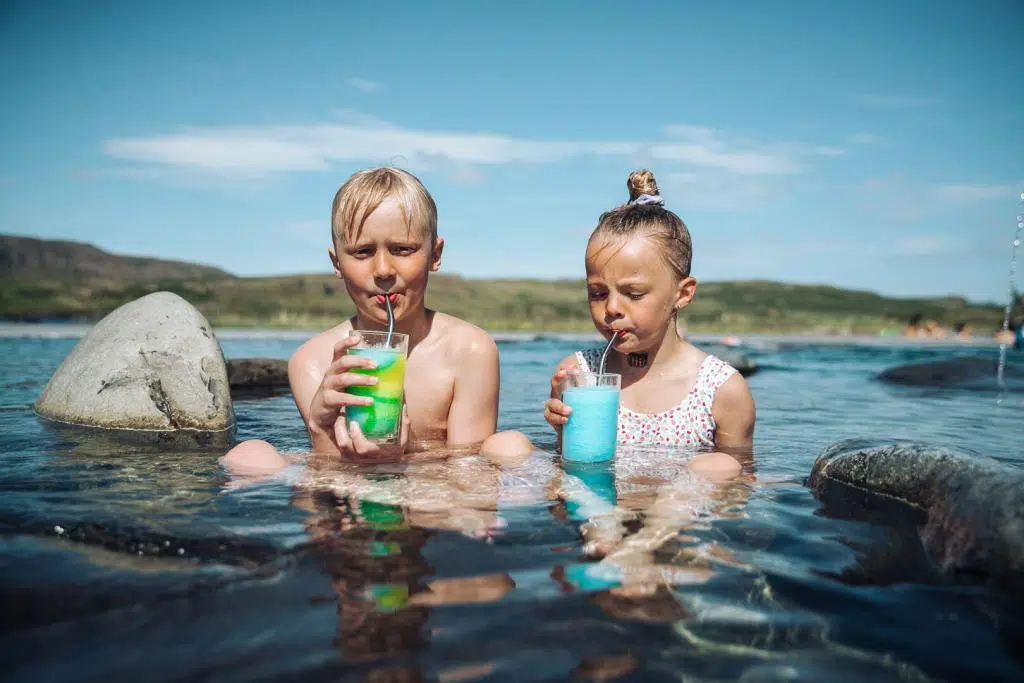
For a swim, I always point people to Vök Baths near Egilstaðir if they want something truly special — floating in geothermal water with views over the lake is hard to beat. But honestly, the local swimming pools scattered around the Eastfjords are just as much of a recommendation, maybe more so. They’re not on many tourist itineraries, which means they’re relaxed, unhurried, and full of locals. Sit in the hot pot long enough, and someone will start talking to you about their week, their grandchildren, etc. That kind of connection is rare, and you won’t find it in the bigger tourist spots.
For food, I’d recommend trying out the small local cafés and restaurants on the way. My favorite is Beituskúrinn in Neskaupstaður – I’ve worked my way through most of the menu, and it has not disappointed me once. The setting helps — right by the water, the kind of place where you sit down for lunch and somehow end up staying for two hours. But it’s genuinely the food and the warmth of the place that keep bringing me back. 10/10, no hesitation.

Head to Stórurð
And then there’s Stórurð. I haven’t made it there myself yet — it’s still on my list — but I keep hearing the same thing from everyone who has done it: that it’s one of the most extraordinary hikes in Iceland. Ancient boulder fields, crystal-clear pools between the rocks, mountains rising on all sides. The kind of landscape that makes you feel very small in the best possible way. Remarkably few visitors know about it, which feels almost like a secret worth protecting — but also worth sharing with the right people. If you’re coming to the Eastfjords and you have one full day for hiking, Stórurð might be it.
The East of Iceland rewards curiosity. The more you’re willing to wander without an agenda, the more it gives back.
Did you enjoy this article?
Get more Iceland insight — straight from a local who's lived here his entire life
Join 8,000 travellers getting honest Iceland advice and unlock exclusive discount codes from 50+ hand-picked Icelandic operators.- ✔ Instant access to exclusive discount codes
- ✔ Savings on tours, car and camper rentals
- ✔ Tips and inspiration for planning your Iceland trip
No spam. Unsubscribe any time.