

Join 8,000 Iceland Travel Fans & Unlock Exclusive Discounts
Get Iceland advice straight from a local. Subscribe and unlock exclusive discounts from 50+ hand-picked Icelandic operators.
- ✔ Instant access to exclusive discount codes
- ✔ Savings on tours, car, and camper rentals
- ✔ Tips and inspiration for planning your Iceland trip
The brilliant photographer Eyrún Lydía is a friend of the magazine. I interviewed her after I discovered her wonderful photos of Icelandic nature some three years ago. Eyrún was gracious enough to take the time to share some very helpful photography tips with my readers. Three years have flown by, but Eyrún has not been sitting still. Far from it. Her Instagram feed shows an adventurous woman who never stops taking on new challenges.

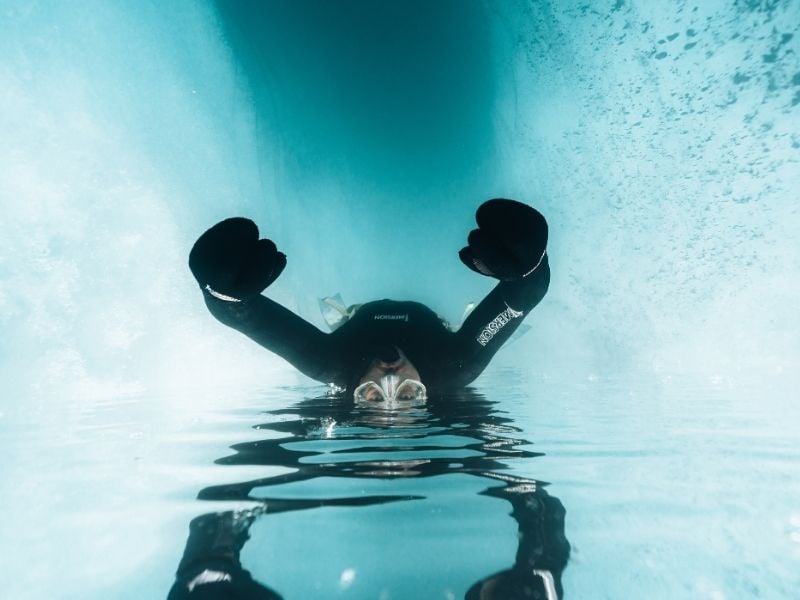
A recent professional high point for Eyrún was being featured in Vogue, but I wanted to hear from her about an extraordinary project she just completed — one that has never been done in Iceland before. Somehow, Eyrún got the idea to freedive into a supraglacial lake and photograph a diver inside it. After more than a year of planning, she and her team finally lived the dream: they ventured onto Fjallsjökull, a southern outlet of the massive Vatnajökull glacier, and returned with stunning photographs.

But what’s the big deal, you might ask? People dive and take photos underwater all the time. So let’s put this into context. Imagine the body of water you want to photograph is sitting high up on an Icelandic glacier. You have to haul yourself and all your equipment up there. That is never easy.

Next, the water is near freezing — after all, it is glacial meltwater. And the lake itself is temporary. You might spot a promising one from your drone, only to find it gone by the time you arrive. The reason is simple: glaciers are constantly moving, cracking, and shifting. At any moment, a supraglacial lake can empty out through a crack in the ice. Should that happen while you are in it, the consequences could be harsh.

It is safe to say it would take a hefty bribe to get me to participate in a project like this!
Video: Freediving in a glacier
You are an experienced glacier guide. When did you first notice these supraglacial lakes forming, and at what point did you start thinking, “I want to get inside one with a camera”?
As a glacier guide, I had been seeing supraglacial lakes for years. Every summer, they appear in different shapes and sizes across the glaciers, and I was always fascinated by them.
The idea of photographing inside one didn’t come all at once. It started as curiosity. Every time I came across a particularly beautiful lake, I found myself wondering what it looked like beneath the surface.

I also wanted to photograph glaciers in a new, fresh, and unique way, something that hadn’t been done before. I love creating images that make people stop and react, even if that reaction is simply, “What was she thinking? She’s crazy!”
As a photographer, I’m always drawn to places that people rarely experience, and I realized that very few people had ever seen the inside of a supraglacial lake, let alone photographed one. The more I thought about it, the more I felt it was a story worth telling.
Did you undertake any training in preparation for the project, and was that sufficient to prepare you for the real thing?
Yes, a lot of preparation went into the project, although not all of it looked like traditional training.
Adam, the freediver/model, and I spent a lot of time talking through different scenarios and potential risks. We were constantly asking ourselves, “What happens if this goes wrong?” and thinking through as many possibilities as we could before stepping onto the glacier.

I also had to learn more about freediving itself. As a photographer, I wanted to understand how a freediver moves underwater, what they need to feel comfortable, how long they can stay submerged, and how we could work together efficiently in such a cold environment.
Before the expedition, we trained at Davíðsgjá and took test shots. Those sessions allowed us to test both the creative and practical sides of the project. I wanted to see how the camera would react to the cold and how our bodies would handle repeated exposure to cold water.
A lot of it was trial and error. We learned what gear we needed, what we didn’t need, and how to make the experience as safe and comfortable as possible.

Perhaps the most important lesson was understanding everyone’s limits, both human and technical. I never wanted to push anyone beyond what felt safe or comfortable. By the time we reached the glacier, we had a much better understanding of our own limits and the camera’s limits, which gave us the confidence to carry out the project safely.
You spent weeks flying drones over glaciers, waiting for the right lake to appear. Walk us through that scouting process — what makes one supraglacial lake “right” and another one not?
The scouting process was probably one of the most challenging parts of the project. Since I don’t live or work in East Iceland, I couldn’t constantly monitor the glaciers myself. I made several trips to scout potential lakes, but more often than not, it wasn’t successful; I found nothing.

Fortunately, I had a fantastic group of friends who helped me. Many of them live in the area and have drones, so they were able to keep an eye on the glaciers and let me know when they spotted potential lakes. I’m incredibly grateful for their help because the project wouldn’t have happened without them.
What made a lake “right” wasn’t just how beautiful it looked from above. We needed a lake that was large enough for both Adam and me to work in comfortably. It needed to be spacious enough to move around and create different compositions without feeling cramped. I also wanted a lake that let in plenty of light, as it was essential for the photographs.
As spring turned into summer, I started to wonder whether the project would actually happen at all. The glaciers weren’t behaving the way I had expected, and we simply weren’t finding the right lake. Then, out of nowhere, I got a message saying, “I think I found a lake that might be exactly what you’re looking for.”
When I saw the drone footage, I couldn’t believe it. Not only had we found one lake that was around 10 meters deep, stunningly blue, and slightly mysterious in its depth, but right beside it was a second lake that was shallower, around five to six meters deep, and incredibly open. It had this beautiful turquoise, almost baby-blue color that I absolutely love. Most importantly, it gave us enough space for everyone involved in the project to work comfortably and safely.
It took months of patience, a lot of help from friends, and a fair bit of luck to find it.

Convincing your friend Adam Scanlon to be the model in freezing meltwater can’t have been a small ask. How did that conversation go, and what kind of person says yes to something like this?
It’s actually quite funny. I am fortunate to have a few friends who I can call with a completely ridiculous idea, and instead of asking, “Why”, they just say, “When.” Adam is definitely one of those people.
I remember telling him that I wanted to photograph a freediver and create something that had never been done before on the glaciers in Iceland. His response was basically, “Sure, as long as there’s hot chocolate waiting for me afterward.” I said, “Deal,” and that was pretty much the start of the project.
But Adam wasn’t the only one. The same was true for Fab, our videographer. I knew he would be up for the adventure immediately. The video was such an important part of the project because it helps people understand what was actually involved. The photographs tell one story, but the video shows the reality of it all. Carrying gear onto a glacier, getting ready, stepping into freezing water, and trying to create something completely new.
What kind of person says yes to a project like this? Someone who’s curious, adventurous, and willing to embrace a bit of uncertainty. More importantly, someone who trusts the people around them. That’s probably what I’m most grateful for. I surrounded myself with people I trust completely. We had never photographed or filmed a freediver in a supraglacial lake before, so there wasn’t a guidebook telling us how to do it. There were definitely moments when I felt nervous, but I knew everyone on the team was incredibly capable. They trusted me, I trusted them, and together we figured it out.
In the end, it felt less like work and more like a group of friends going on an adventure and creating something special together.

You’ve said you are “drawn to danger” — but you also clearly take safety extremely seriously, with dedicated safety leads on both the glacier and the freediving side. How do you balance those two sides of yourself?
What I’m actually drawn to is environments that are unpredictable and demanding, places where you can’t fully control the outcome. But that’s exactly why safety becomes such a big part of the process for me. The more complex and uncertain the environment is, the more structure and planning you need.
With this project, that balance was very intentional. We had dedicated safety personnel on both the glacier and freediving sides, and their role wasn’t optional; it was central to everything we did. My job as a photographer is to focus on the creative side, but that only works if I know that someone else is fully responsible for watching the environment, the water, the ice, and the people.
For me, safety doesn’t take away from the adventure; it’s what makes it possible. If anything, it allows me to go further creatively, because I know the risks are being actively managed rather than ignored. So it’s not really a balance between danger and safety. It’s more a balance between curiosity and discipline. Curiosity pulls me into these environments, but discipline is what allows me to actually work there and come home safely.

Tell us about your camera setup for this shoot — and how it held up in those conditions?
I used my Sony A7 IV with a Sony 16–35mm f/2.8 GM in an underwater housing.
The setup itself is relatively simple. The biggest challenge wasn’t just the cold water, but everything that comes with working in that environment, condensation, battery performance, overheating, and handling the camera with neoprene gloves – it’s a challenge!
We had about 30 minutes in each lake, so there was never much time to work. In those conditions, everything has to be efficient and very intentional.
When I was doing practice dives, I paid close attention to how the camera would behave after repeated entries into the water. Whether the seals stayed reliable, and how the housing performed when moving so much. I also chose the Sony 16–35mm f2.8 GM partly because it’s heavier, helps balance the housing, and gives you more control underwater. It’s still my favorite lens to this day – I also mentioned it in my last interview with you, only now I use it underwater. The range feels endless, and I love how much space it gives you in the frame; you can really place the freediver within the environment and show everything happening around them, not just the subject itself.
The Sony system performed consistently, even in those low temperatures, which gave me the confidence to focus on the creative side rather than worrying about the gear. But I definitely learned a lot about working fast, staying organized, and keeping everything as dry and controlled as possible.

For travelers visiting Iceland who want to see the world of glaciers up close — without freediving into one — what would you recommend they do, and what should they know before they go?
There are so many ways to experience glaciers in Iceland without going anywhere near the extreme side of what we did.
I would always recommend joining a certified glacier guide if you want to step onto the ice itself. Even on well-traveled routes, glaciers are constantly changing environments, and you need someone who understands crevasses, weather, and conditions on that specific day.
For people who just want to see them up close, there are incredible viewpoints and glacier lagoons across the country. Places like Sólheimajökull, Jökulsárlón, and Fjallsárlón are perfect for safely experiencing icebergs and glacial landscapes, and they still give you a real sense of scale and movement.
If you want something a bit more immersive, guided hikes onto outlet glaciers are an amazing way to actually walk on the ice and understand how dynamic it is.
What I always tell people is that glaciers aren’t something fixed or permanent. They are constantly moving, melting, and reshaping, and that’s exactly what makes them so special – you just have to approach and experience them with the right level of respect.

Eyrún Lydía with her Sony A7 IV in its underwater housing, mid-shoot on Fjallsjökull. Photo by Fabiano Latham.
For someone who’s only ever seen Iceland in photographs, what’s the one thing they should make sure to experience in person?
I think the one thing people don’t expect in Iceland is the sense of space and the way nature completely takes over your experience of a place. That you’re surrounded entirely by natural elements. Wind, weather, wildlife, and ice cracking become the only things you hear and feel. It’s a kind of natural soundscape that a lot of people aren’t used to anymore, and it changes the way you experience a place.
For me, it’s often those in-between moments that stay with people the most, where you suddenly become very aware of how small you are in the landscape. You can see Iceland in photographs, but it’s only when you’re actually here that you understand the scale, the distance, and how alive the environment feels. I’ve had days where that relationship felt very real.
I remember driving with guests toward a glacier in really thick fog, thinking they were going to miss the entire experience because visibility was almost zero. I didn’t really know what to do except trust the process and keep going. Then, as we arrived, the fog suddenly lifted, and we had perfect conditions for about an hour, just enough time to walk, photograph, and experience the glacier properly. And then, as soon as we left, the weather closed in again. This kept repeating throughout the day: we would arrive somewhere, the conditions would open up, the group behind us would arrive, and then it would disappear again.
At one point, someone even joked that I must be controlling the weather because it kept happening like that. I felt a bit like a witch, but really, it just made me incredibly grateful. It reminded me that when you move through these landscapes with respect and awareness, you’re very small in them – but you’re also very much part of the experience, and sometimes it feels like nature responds to that.
To the most amazing team ever!
Video and BTS: Fabiano Latham @fabsnaps.official
Model: Adam Scanlon @adams.adventure
Glacier Safety: Mike Reid @wildmikereid
Freediving Safety: Weston Neal
Assistants: Catherine Rivadeneyra @milesbycath , Weston, Joe and Kevin
Drone Scouting: Julien Leclercq @julienleclercqiceland and Mike Reid
Photographer and Production: Eyrún Lydía @eyrunlydia
Did you enjoy this article?
Get more Iceland insight — straight from a local who's lived here his entire life
Join 8,000 travellers getting honest Iceland advice and unlock exclusive discount codes from 50+ hand-picked Icelandic operators.- ✔ Instant access to exclusive discount codes
- ✔ Savings on tours, car and camper rentals
- ✔ Tips and inspiration for planning your Iceland trip
No spam. Unsubscribe any time.