

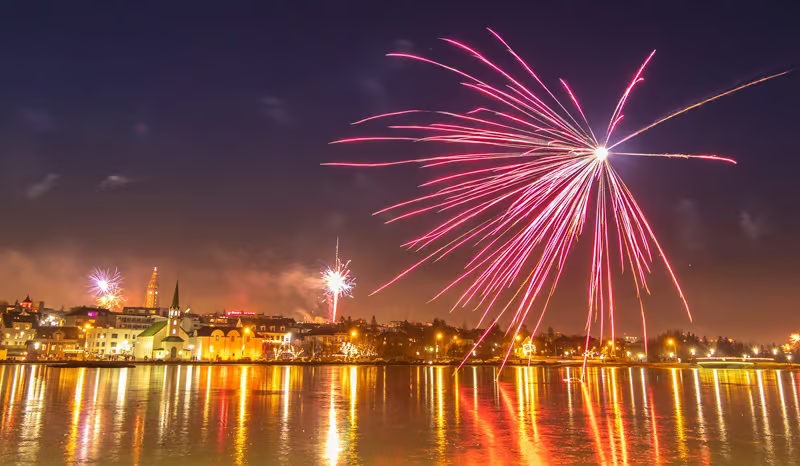
New Year’s Eve is the one night of the year when this quiet country completely loses its mind. There is no official fireworks display in Reykjavík. No municipal show, no cordoned-off viewing area, no man on a microphone counting down. Instead, roughly every household in the city buys a box of fireworks and sets them off from their own street at the same time, and the result is an hour of noise and light that visitors tend to describe afterward as slightly unhinged.
It is also, and I say this as somebody who has stood out in it for fifty-odd years, one of the genuinely great nights anywhere. Here is how it actually works, and how to be in the right place for it.
The night, hour by hour
Nothing about this is officially scheduled, but it happens the same way every year, and it runs roughly like this.
Through the afternoon. Shops close early — usually around midday or just after — and buses stop running in the afternoon. Get whatever you need before lunchtime. This catches people out every year.
Around half eight in the evening. The neighborhood bonfires are lit. This is the social part of the night.
Half ten. The streets empty almost completely. Everybody has gone indoors to watch Áramótaskaupið on television. If you are outside at this hour, you will wonder where the entire population went.
Half eleven onwards. The show ends, people come back out, and the fireworks build steadily.
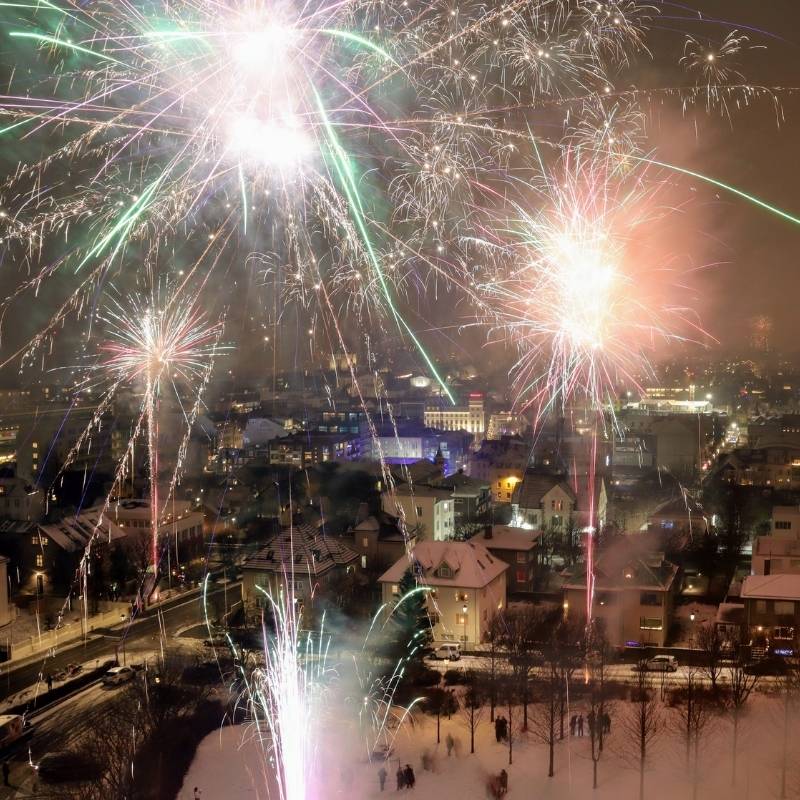
Midnight. Everything at once, from every direction, for about half an hour. This is the part nobody forgets.
After that. The bars fill up and stay open very late.
1 January. Closed. All of it. Sleep in.
6 January, Þrettándinn. The last bonfires and the last fireworks, and then Christmas is properly over. We Icelanders do our best to cope with January and February.
Bonfires and community spirit
Long before midnight, neighborhoods across Reykjavík light bonfires — casual, fiery meet-ups where locals and visitors mingle, sing, and set off sparklers. They start around half eight, and they are the easiest way into the evening: nobody is on a guest list, nobody minds that you are a visitor, and standing near a large fire is a reasonable thing to be doing in an Icelandic winter.
The city publishes the locations each December. Check the Reykjavík city website nearer the time for that year’s list — the sites move around, and a couple of the long-standing ones have been dropped in recent years.
Fireworks everywhere, and who is selling them
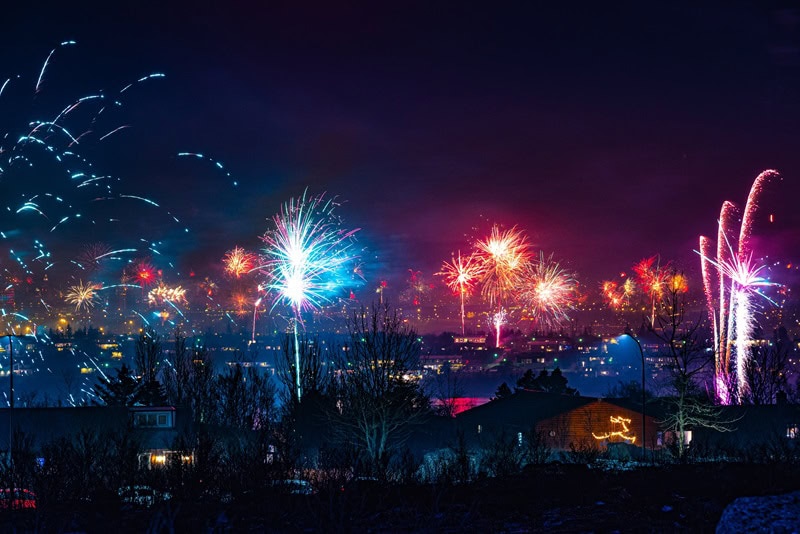
In Iceland there is no official display, because the spectacle is the crowd. Icelandic law allows the public to buy and set off fireworks from 28 December to 6 January, and ICE-SAR, the volunteer Icelandic Association for Search and Rescue, sells them almost entirely.
That is worth understanding rather than skimming past. ICE-SAR are the people who come and find you when your car goes off a road in a blizzard, and they are unpaid. This one week of fireworks sales funds much of their year. So when you watch the sky go up at midnight, you are watching the country’s mountain rescue budget being spent in public, which is a strange and rather good arrangement.
Can visitors buy fireworks?
Yes. Anybody can walk into an ICE-SAR stand and buy them, and plenty of visitors do. The stands go up around town from 28 December, and they are hard to miss. Buy eye protection at the same time — they sell that too — and read the instructions, because the boxes are not gentle and the people around you will be setting theirs off at the same time from about three meters away.
Where to watch the fireworks in Reykjavík
Honestly, almost anywhere. The whole city goes up at once, so you do not need a special spot so much as an open one.
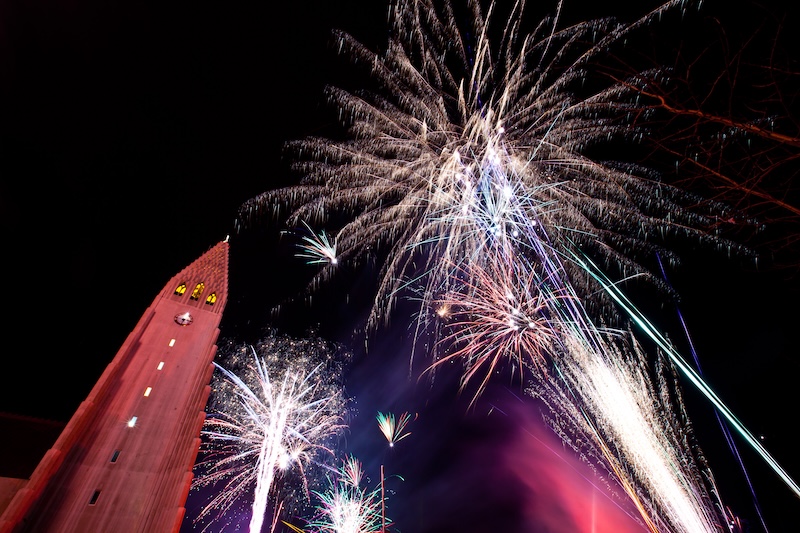
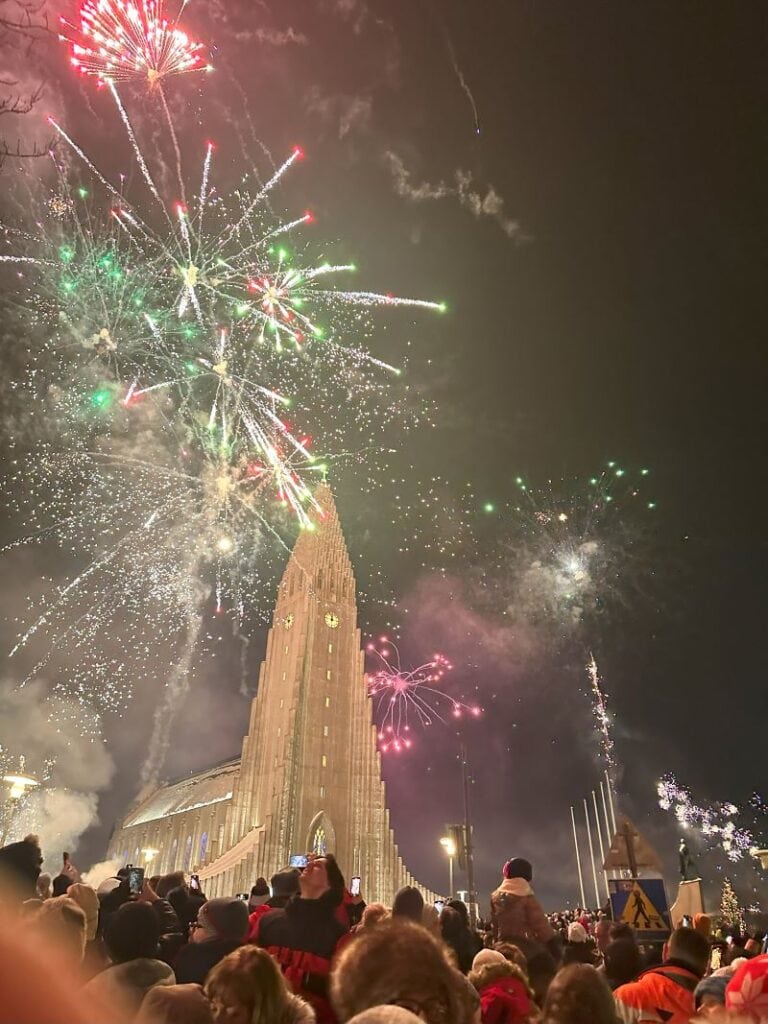
That said, I recommend the following places: Hallgrímskirkja, where the crowd is thickest, and the church is lit from below by the fireworks going off in the square. That magnificent building is the perfect backdrop to the fireworks.
Klambratún and Landakotstún are open parks with room to stand back. And Öskjuhlíð, the wooded hill under Perlan, gives you the whole city at once — which is the view to choose if you want to see the scale of the thing rather than be in the middle of it.
Áramótaskaupið, and why the streets go empty at half ten
At half past ten the entire country stops and watches the same television program. Áramótaskaupið is a satirical review of the year — politicians, scandals, whatever we have all been arguing about since January — and it has run since 1966. Watching it is not optional here in any real sense. Roughly nine out of ten people with a television on are watching it.
If you are outside at that hour, you will find a city that looks evacuated. It is genuinely eerie and worth seeing for five minutes.
You can watch it yourself on RÚV, and plenty of bars and hotel lobbies put it on. You will not follow the jokes without Icelandic, and the room laughing around you is most of the point anyway.
On a personal note, my New Year’s Eve is always fantastic. We always go to my sister’s house, where the extended family enjoys a lavish dinner, has ‘some’ champagne, and watches the Áramótaskaupið. Then we head up to Hallgrímskirkja to join the madness there. The after-party will extend into the new year!
Watching it from the water
If you would rather not stand in a crowd with fireworks going off at head height, go out on the bay. Elding runs a New Year’s Eve cruise out of the old harbor, and from Faxaflói you see the whole city light up at once rather than the one street you happen to be standing in.
Readers get 10% off with my exclusive discount code for this experience and many more. Sign up for my discount codes to get it instantly. Book it on the Elding website and enter the code at checkout.
Book this early. It is one sailing, one night a year, and it sells out well in advance.
The rest of the codes
The Elding code above is a taster. I run reader discount codes with around fifty Icelandic operators — tours, car and camper rental, lagoons, indoor attractions — and I send the full list free to anyone on my newsletter. No charge, and I do not sell your address to anybody.
Lava Show is open through the holidays
Like a lot of Icelanders, I have more than one job. I am also the Sales and Marketing Manager at Lava Show, where we pour real molten lava into a room a few meters from the audience, so take my enthusiasm accordingly. Instead, just read our reviews!
We are open every day through the holidays, with showtimes in Reykjavík every two hours from 10 am to 8 pm, and we are open in Vík over Christmas and New Year as well. Book online before you come — it sells out fast at this time of year.
What is open, and what is not
Hours change every year, so confirm what matters. But the pattern holds.
31 December. Shops shut early, usually around midday. Buses stop in the afternoon. Museums and most attractions close early or not at all. Restaurants that open at all offer set New Year menus and will be fully booked for weeks.
1 January. Effectively everything is closed, including most restaurants and all the shops. Swimming pools usually open for a few hours in the afternoon, which is the single best thing you can do with a New Year’s Day in Iceland. Check the day before.
2 January onwards. Normal life resumes.
So: buy food on the 30th or the morning of the 31st, book your New Year’s Eve dinner months ahead if you want one, and plan nothing at all for the 1st beyond a long walk and a hot pool.
What to wear, and how not to get hurt
It is the end of December, and you will be standing still outdoors for a couple of hours in the middle of the night. Thermals, wool, a waterproof outer layer, proper boots with grip, a hat, and gloves. This is not a night to be stylish and cold.
Eye protection is the one thing people skip and should not. Fireworks are being set off by amateurs at close range in every direction; spent casings come down, and the smoke by midnight is thick enough that you cannot see across a street. ICE-SAR sells protective glasses at the same stands as the fireworks. Buy a pair.
More on the clothing: how to dress for Iceland, and how to rent the gear instead of buying it.
After midnight
Once the sky clears, downtown Reykjavík fills up, and the bars stay open until four or five in the morning. It gets rowdy. It is friendly rowdy — this is a small country, and people are mostly out with their neighbors — but it is a proper night out, and you should expect queues.
If that is not your evening, the alternative is the one locals with children choose: home by one, up late on the 1st, and a swimming pool in the afternoon.

Þrettándinn — the actual ending
Christmas here doesn’t end on the 26th. It runs thirteen days and ends on 6 January, Þrettándinn, with a final round of bonfires and the last of the fireworks going off. By tradition, the elves hold a party and the last Yule Lad goes home.
Almost every visitor has flown out by then, which is a shame, because it is a quieter and in some ways better night than the 31st.
The whole thirteen days are written up here: how to celebrate Christmas the Icelandic way, and if you are in town for the week before, Reykjavík at Christmas covers what is open and what to do.
Uncle’s advice
Do not over-plan this one. You do not need a ticket, a table or a viewing platform to have the night of your life on 31 December in Reykjavík — you need warm clothes, eye protection, and to be outdoors somewhere with a bit of sky at midnight.
Sleep in on the 1st. Go to a pool in the afternoon. Let the year start slowly.
Before you go
Join the newsletter, and I will send over the full list of reader discount codes for free, along with whatever I have learned lately about traveling here.
Save on tours and activities over Christmas and New Year’s
Iceland isn’t a cheap place to spend the holidays. That’s why I’ve spent years building up a list of discount codes that our partners give only to Stuck in Iceland readers. They’re local companies I know and trust, and the codes work over the Christmas season too.
Here’s where they come in handy over the holidays:
- Northern Lights tours. The long December nights give you plenty of chances. Pick a bus tour, a small-group Super Jeep or a boat trip from the old harbour, all leaving from Reykjavík.
- Geothermal pools and lagoons. Nothing beats sitting in hot water while snow falls around you. Several of our partners are an easy day trip from the city.
- Walking and food tours. A local guide shows you the Christmas lights downtown and tells you the stories behind them. A food tour is a good way to taste Icelandic holiday treats.
- Indoor experiences. On days when the weather turns, head to FlyOver Iceland, Aurora Reykjavík or Lava Show. They’re warm, dry and right in town.
- Storytelling evenings. Want more trolls, Yule Lads and Christmas cats? A Viking story night is a cosy way to spend a dark evening.
You’ll find every code on our Iceland tour deals page. Subscribe to the Stuck in Iceland newsletter to unlock them. It’s free, and I send one email a week with practical tips for your trip.
A few words of advice. Many tours run shorter schedules on Christmas Eve, Christmas Day and New Year’s Eve, and most shops and restaurants close early. Book ahead, and check times, terms and discounts with the company when you book, as these can change. And don’t overdo it. You’re on holiday. Sleep in, pick one good activity a day, and leave time for the lights, the pools and the New Year’s Eve fireworks.
Questions people ask me about New Year’s Eve in Iceland
Is there an official fireworks display in Reykjavík on New Year’s Eve?
No. There is no municipal show and no organised display. Ordinary people buy fireworks and set them off from their own streets, so the whole city goes up at once around midnight. That is why it looks the way it does — there is no single place to stand because the display is happening everywhere.
What time do the fireworks start in Reykjavík?
They build through the evening and peak at midnight, when almost everyone lets off their boxes at the same time for about half an hour. There is a distinct lull between about half ten and half eleven while the country watches Áramótaskaupið on television, and then it picks up again.
Can tourists buy fireworks in Iceland?
Yes. Anyone can buy them from the stands run by ICE-SAR, the volunteer search and rescue association, which appear around town from 28 December. Icelandic law allows the public to buy and set off fireworks from 28 December to 6 January. Buy eye protection at the same stand and read the instructions on the box.
Where are the New Year’s Eve bonfires in Reykjavík?
Neighbourhood bonfires are lit around half past eight in the evening at sites across the city. The locations change from year to year and the city publishes the current list each December, so check the Reykjavík city website nearer the time rather than relying on an old list.
What is Áramótaskaupið?
A satirical television review of the year that has run since 1966 and goes out at half past ten on New Year’s Eve. Almost the entire country watches it at the same time, which is why the streets empty out completely for an hour. You can watch it on RÚV, and many bars and hotel lobbies put it on — you will not follow the jokes without Icelandic, but the room laughing around you is most of the experience.
What is open in Reykjavík on New Year’s Eve and New Year’s Day?
Shops close early on 31 December, usually around midday, and buses stop running in the afternoon. On 1 January almost everything is shut, including the shops and most restaurants, though swimming pools often open for a few hours in the afternoon. Normal life resumes on 2 January. Hours change year to year, so confirm anything that matters to your plans.
Do I need to book a restaurant for New Year’s Eve in Reykjavík?
Yes, and months ahead rather than weeks. The restaurants that open at all on 31 December run set menus and fill up long in advance. If you have not booked, plan to eat early, eat at your hotel, or buy food before the shops close at midday.
Where is the best place to watch the fireworks in Reykjavík?
Hallgrímskirkja has the biggest crowd and the church lit from below by fireworks going off in the square. Klambratún and Landakotstún are open parks with room to stand back. Öskjuhlíð, the hill under Perlan, gives you the whole city at once, which is the view to pick if you want to see the scale of it. A boat on Faxaflói bay gives you the same panorama from the water.
Is New Year’s Eve in Iceland safe?
It is friendly rather than threatening, but the fireworks are genuinely a hazard. Amateurs are setting off large boxes at close range in every direction, spent casings come down, and the smoke by midnight can be thick enough that you cannot see across the street. Wear eye protection, keep your distance from other people’s boxes, and do not stand downwind in the middle of it.
What should I wear on New Year’s Eve in Reykjavík?
You will be standing still outdoors in the middle of a winter night for a couple of hours. Thermals, wool layers, a waterproof outer shell, boots with real grip, hat and gloves. Add eye protection for the fireworks. This is not the night to choose an outfit over staying warm.
Can you see the northern lights on New Year’s Eve?
Occasionally, but do not plan on it. The city is brightly lit, the smoke from the fireworks hangs over everything by midnight, and both work against you. If the aurora is the reason you came, give yourself other nights for it and away from the city lights.
When does Christmas actually end in Iceland?
On 6 January, Þrettándinn — the thirteenth day. There are final bonfires and a last round of fireworks, and by tradition the elves hold a party and the last Yule Lad goes home. Most visitors have flown out by then, which is a shame, because it is quieter and in some ways better than the 31st.
